
Content Governance and Workflows for Higher Education: Why Your Website Needs Clear Rules

Central marketing wants brand consistency. Academic departments want autonomy. The question is how to give departments ownership over their content without letting the website become a maze of contradictions and outdated pages.
Content governance establishes who can publish what, how content moves from draft to live, and what technology enforces those decisions automatically.
This guide breaks down the three pillars of effective content governance for higher education:
- Defining roles and permissions
- Building workflows that match institutional risk tolerance
- Configuring your CMS to enforce rules automatically
Each section includes practical frameworks, common pitfalls to avoid, and implementation strategies that stick.
Why Universities Struggle With Content Governance
Higher education runs on distributed authority, with academic departments, research centers, athletic programs, and student organizations all maintaining their own web presence. This structure creates genuine value: faculty expertise shapes how programs present themselves, and local ownership keeps content fresh.
But decentralization without governance creates predictable problems. Different offices publish their own versions of financial aid information and each department interprets visual guidelines differently, so the website looks like it belongs to different organizations.
If you add staff turnover to the mix the problems compound. Universities lose significant institutional knowledge when experienced web contributors leave, taking undocumented processes with them. New hires inherit vague instructions to "update the department website" and make reasonable decisions that might accidentally break established patterns.
Most web contributors also wear multiple hats. An administrative assistant updating the biology department site handles scheduling, budget tracking, and event coordination too. Web publishing represents a fraction of their responsibilities, and they received minimal training before getting CMS access. Governance that depends on these contributors remembering detailed rules fails when they only touch the website a couple of times per month.
Effective governance meets people where they are. Simple interfaces, constrained choices, and automatic enforcement replace reliance on training and memory.
How to Define Roles and Permissions for University Content Teams
Clear role definitions eliminate the ambiguity that make governance difficult across multi-department content teams. Every person with CMS access should know exactly what they can and cannot do, without needing to consult documentation or ask permission.
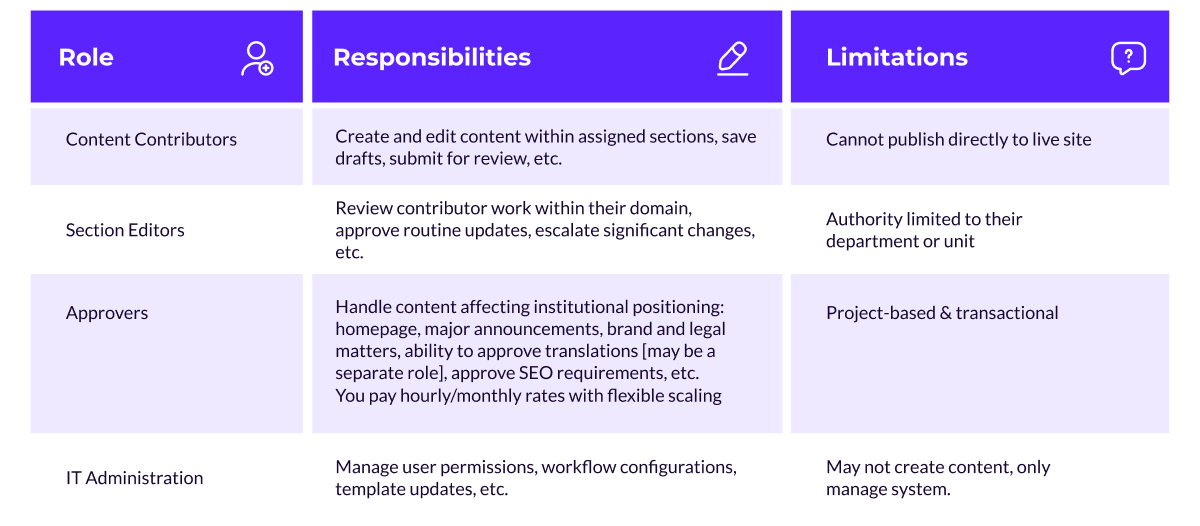
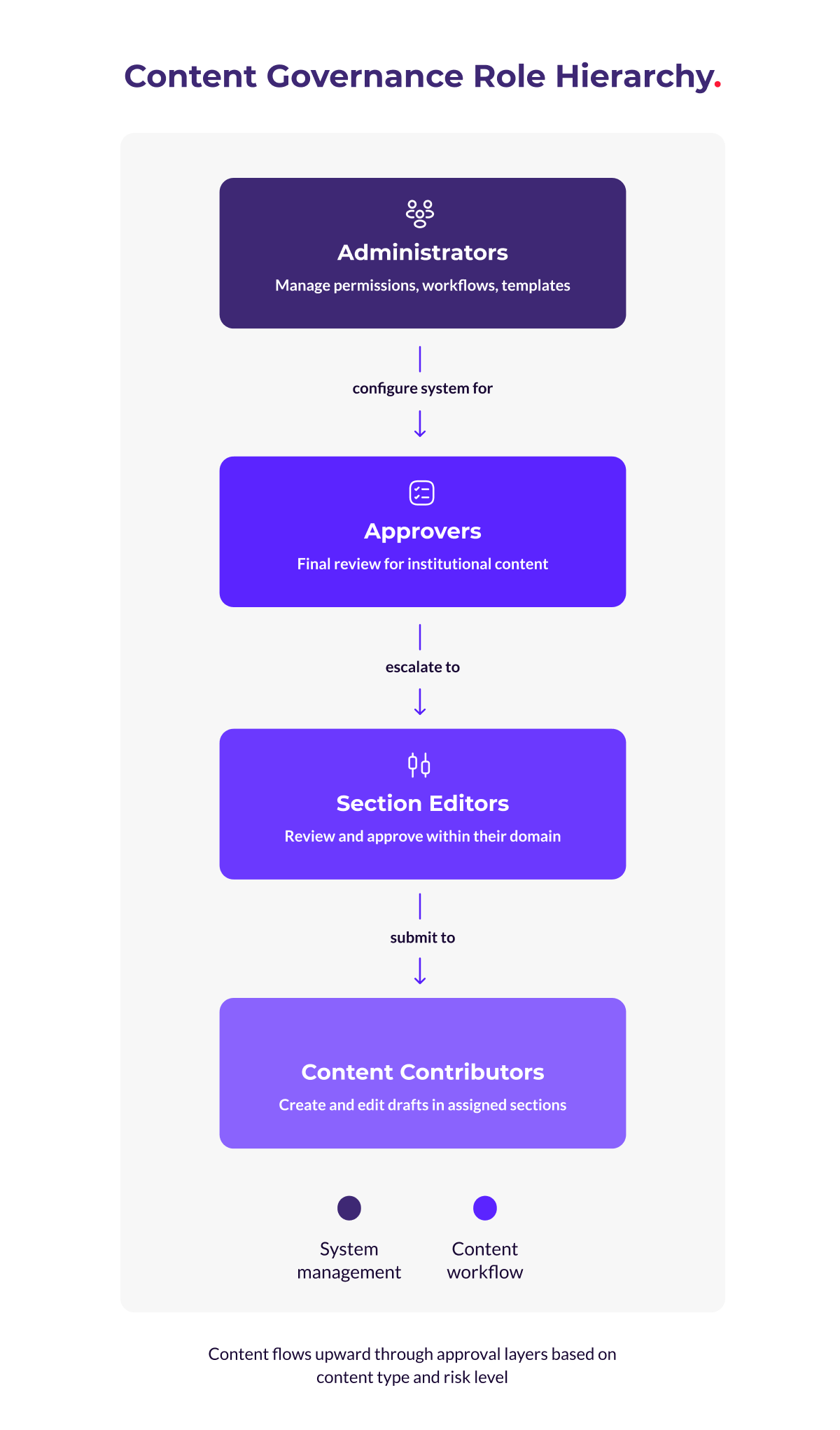
These role definitions come from content governance frameworks we've built across dozens of higher ed institutions. The exact titles vary by campus, but the editorial roles and responsibilities stay consistent.
Role clarity works only when every person knows their role and accepts its boundaries. Stakeholder engagement during role definition increases adoption because people support systems they helped design.
How Should Permissions Match Your Org Chart?
Permissions should mirror how departments operate. An admissions editor reviews all admissions-related content. A college editor oversees pages for their academic unit. Contributors should know exactly who reviews their work and approvers understand their domain of responsibility.
The key is preventing both over-restriction and under-restriction. When permissions are too tight, you get bottlenecks where simple updates wait days for approval from overloaded reviewers. If permissions are too loose, well-meaning contributors make changes with consequences they don't anticipate.
Start by mapping existing content ownership. Identify who
- Currently maintains each section
- Who should review changes
- Who needs final approval authority
Document these relationships before configuring the CMS, since technology should enforce decisions already made rather than drive organizational design.
How to Build Editorial Workflows for Higher Ed Content
Your workflows define the path content travels from creation to publication. Good workflows match institutional risk tolerance: lighter review for low-stakes updates, heavier scrutiny for content affecting reputation or compliance.

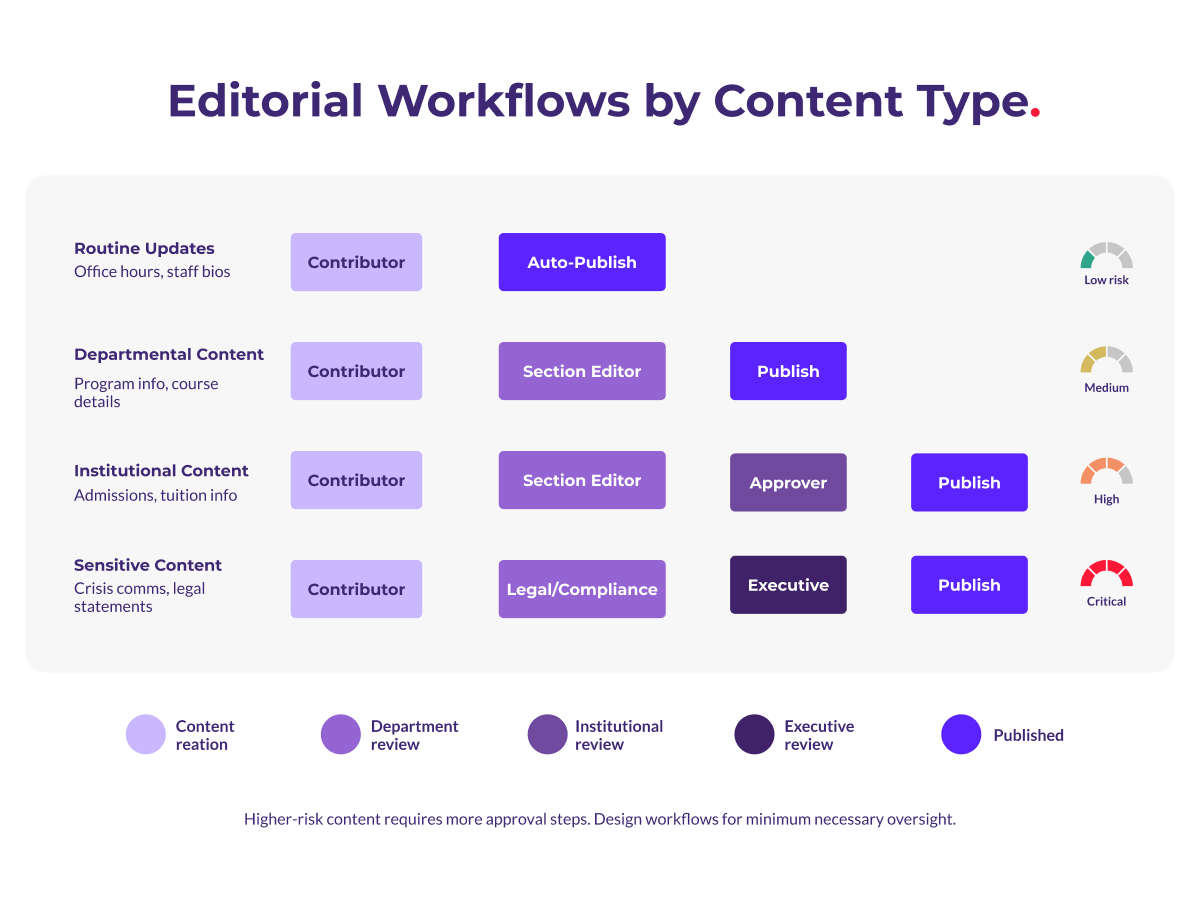
Designing your workflows requires honest assessment of what needs review versus what historically required review because nobody questioned the process.
Unnecessary steps train contributors that the system wastes their time, encouraging workarounds that undermine governance entirely.
Workflows also need to handle exceptions. When an approver rejects content, the system should route it back to the contributor with clear feedback on what needs fixing. When approvers are unavailable, escalation rules prevent content from sitting in limbo indefinitely.
These edge cases matter because they're where most workflow implementations break down.
How to Schedule Content Publishing and Expiration
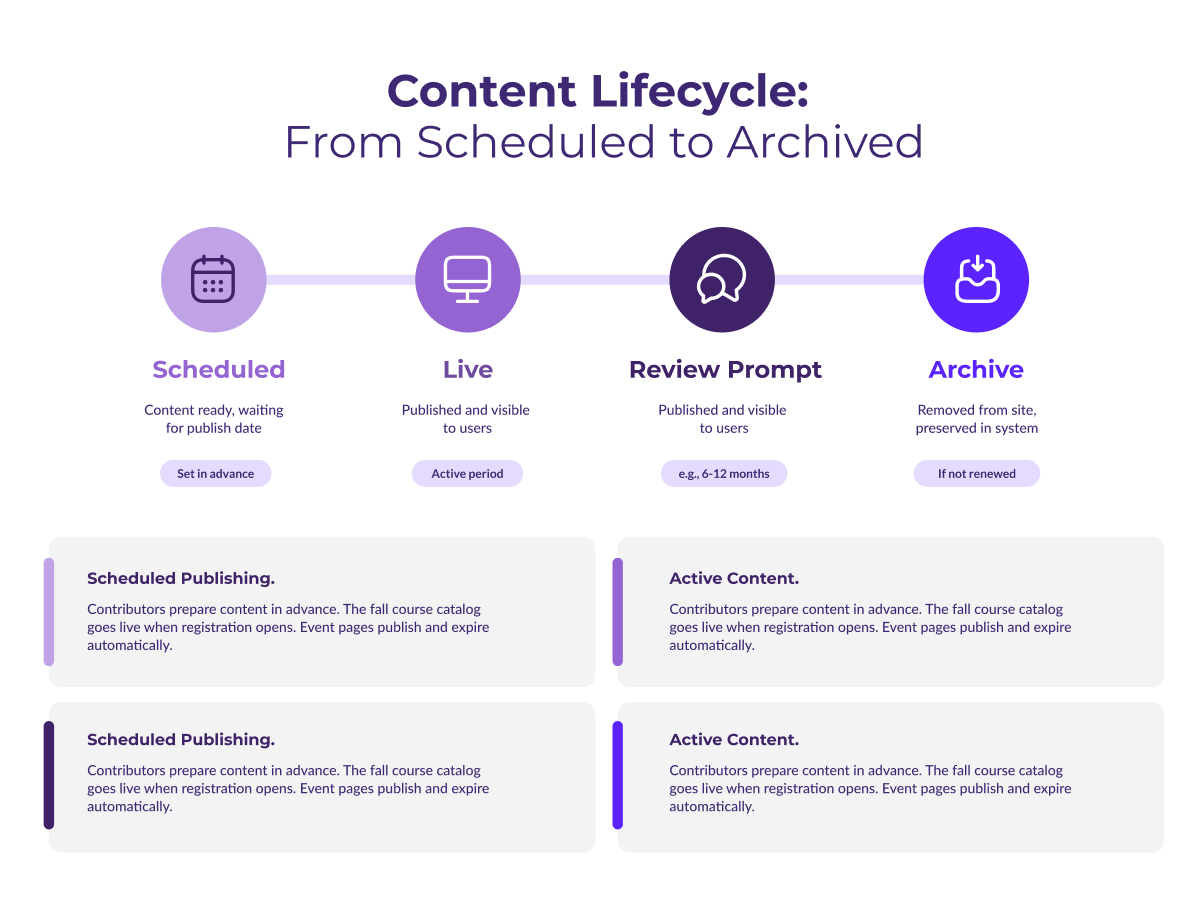
Scheduled publishing handles time-sensitive content without emergency requests. Contributors prepare content in advance and set publication dates, so the fall course catalog goes live the moment registration opens and event promotions expire when they're no longer relevant.
Sunset protocols prevent content from lingering past relevance. When pages go without updates for defined periods, the system triggers review prompts requiring content owners to confirm continued relevance or archive outdated material. Active management prevents the accumulation of stale pages that damage search rankings and confuse users.
What CMS Features Enforce Content Governance?
Governance fails when enforcement depends entirely on human compliance. Your CMS should make following rules easier than breaking them.
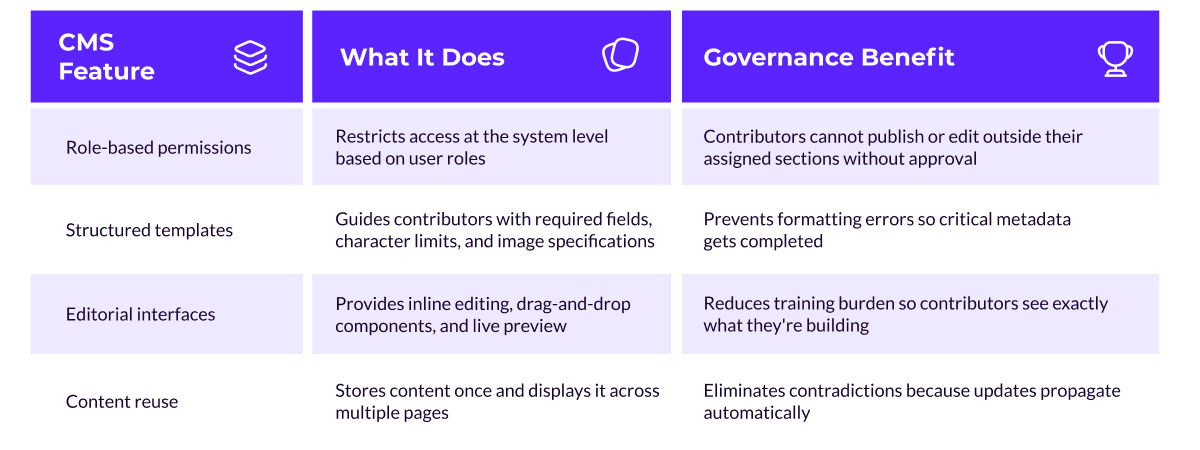
Modern CMS platforms like Drupal provide these capabilities out of the box. Configuration matters more than custom development. The investment lies in setting up the system correctly, not building new functionality.
As a Drupal-focused agency, we've configured these governance controls for institutions ranging from small colleges to large state university systems. The technical setup is straightforward once you know what organizational decisions to encode into the platform.
How Platform Configuration Reduces Training Burden
Templates replace blank pages with guided structures. Required fields capture critical metadata, character limits keep writing concise, and image tools handle resizing automatically.
Contributors work directly on page previews through inline editing rather than filling out abstract form fields. Drag-and-drop components and live preview make the interface intuitive enough that people learn by doing rather than by reading documentation.
Eliminating Duplicate Content at the Source
When tuition information exists once and displays everywhere it's needed, updates propagate automatically. Your editors can't create contradictions because they're not maintaining separate copies. This single-source approach transforms governance from policing behavior to designing systems where mistakes become structurally difficult.
It’s also more efficient, instead of updating the same information across fifteen pages, contributors update one source.
How to Implement Content Governance That Lasts
Knowing what governance should look like differs from making it operational. Implementation requires attention to change management, training, and ongoing maintenance.
Start With Your Biggest Content Problems
If you try to fix everything at once, you'll overwhelm your team and stall. Successful implementations begin with specific, visible problems that governance can solve.
Identify the content issues that generate the most complaints or cause the most damage. Duplicate program pages might confuse prospective students, inconsistent event promotion might frustrate the central calendar team, or brand violations on departmental sites might embarrass leadership. Establishing governance foundations through content audits and stakeholder workshops surfaces these problems systematically.
Starting with these pain points creates quick wins that build momentum and credibility. When governance solves a problem people care about, skeptics become supporters.
Lead With Benefits When Communicating Change
Change management research shows that people support changes they understand. Governance often fails because implementers focus on what's changing without explaining why it matters.
Connect governance to outcomes contributors care about:
- Faster publication through streamlined workflows
- Less confusion from unclear responsibilities
- Reduced rework when templates prevent common errors
- Protection from blame when content approval process document who authorized what
Framing governance as helpful rather than restrictive changes how people receive it. The goal is making contributors' work easier while protecting institutional quality.
Train Editors to Make Judgment Calls
Training that covers only rules and procedures misses the point. Your team needs enough understanding to make good decisions when situations don't match documented scenarios.
Effective training combines initial instruction with ongoing support. Brief onboarding sessions cover essential workflows, while embedded help within the CMS provides guidance at the moment of need. Regular office hours give contributors a place to ask questions as situations arise. Documentation serves as reference material, not primary instruction.
Role-specific training respects people's time. Contributors need different knowledge than section editors. Administrators require deep platform understanding that would overwhelm content creators and tailored training ensures everyone learns what they need without wading through irrelevant material.
How to Track Whether Governance Is Working
Governance isn't a project with an end date. Ongoing measurement identifies what's working and what needs adjustment.
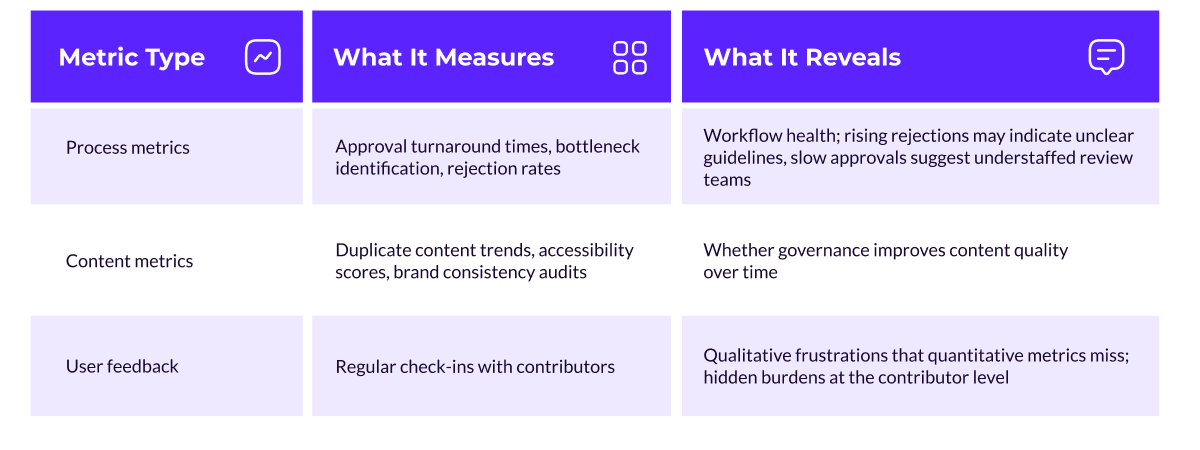
Quarterly reviews examine metrics and adjust governance accordingly. Workflows that seemed appropriate during design might prove impractical in operation.
Your governance needs an owner who wakes up thinking about content quality, workflow efficiency, and platform configuration. When responsibility diffuses across the organization, standards slip and documented processes stop matching reality.
How ImageX Approaches Content Governance
Governance frameworks fail when they're designed in isolation from the people who use them. Our approach starts with understanding how your institution operates: where content decisions get made today, which bottlenecks frustrate contributors, and what risks keep leadership concerned.
From there, we design governance that fits your organizational reality rather than forcing your organization to fit a template. Some institutions need tight central control over brand-sensitive content with loose oversight everywhere else. Others need distributed authority with lightweight review processes.
The right answer depends on your culture, your risk tolerance, and your team's capacity.
Implementation happens in phases. We start with the highest-impact changes, prove they work, and expand from there. This approach builds internal confidence and lets us adjust based on how your contributors respond.
Governance that launches fully formed often fails because it doesn't account for the messy realities of how people work.
Bringing Order to Higher Ed Content Operations
Content governance answers fundamental questions that ungoverned institutions leave to chance:
- Who can publish what?
- How does content move from draft to live?
- What technology enforces the rules?
Universities that answer these questions intentionally gain control over large-scale content operations without sacrificing the distributed ownership that keeps content fresh and relevant. Clear roles eliminate ambiguity, defined workflows match oversight to risk, and platform configuration enforces rules automatically.
The alternative is ongoing chaos: duplicate content, contradictory information, brand inconsistency, and the constant scramble to fix problems that governance would have prevented.
ImageX has helped institutions ranging from small colleges to large universities implement scalable content governance models that scale with their needs. We've reduced content duplication, streamlined approval workflows, and built systems that survive staff turnover because the process lives in the platform rather than in someone's head. Effective governance requires understanding both the technology and the team dynamics that make higher education unique.
Ready to bring order to content chaos? Discuss how governance can work for your institution.