How to Improve Brand Visibility in AI Search Engines: What Marketers Need to Do Now

- Why Traffic Is Down but Performance Can Still Be Up
- How to Get Your Content Cited by AI
- Why Keywords Alone Won't Cut It Anymore
- How to Convert Visitors Who Already Did Their Research
- How to Track Whether Your AI Strategy Is Working
- Three Things to Do This Month
Your website used to do a lot of heavy lifting. It introduced your brand, educated prospects, built trust over multiple visits, and eventually helped them convert. AI search trends are shifting that whole arc in a way most marketing teams haven't fully reckoned with yet.
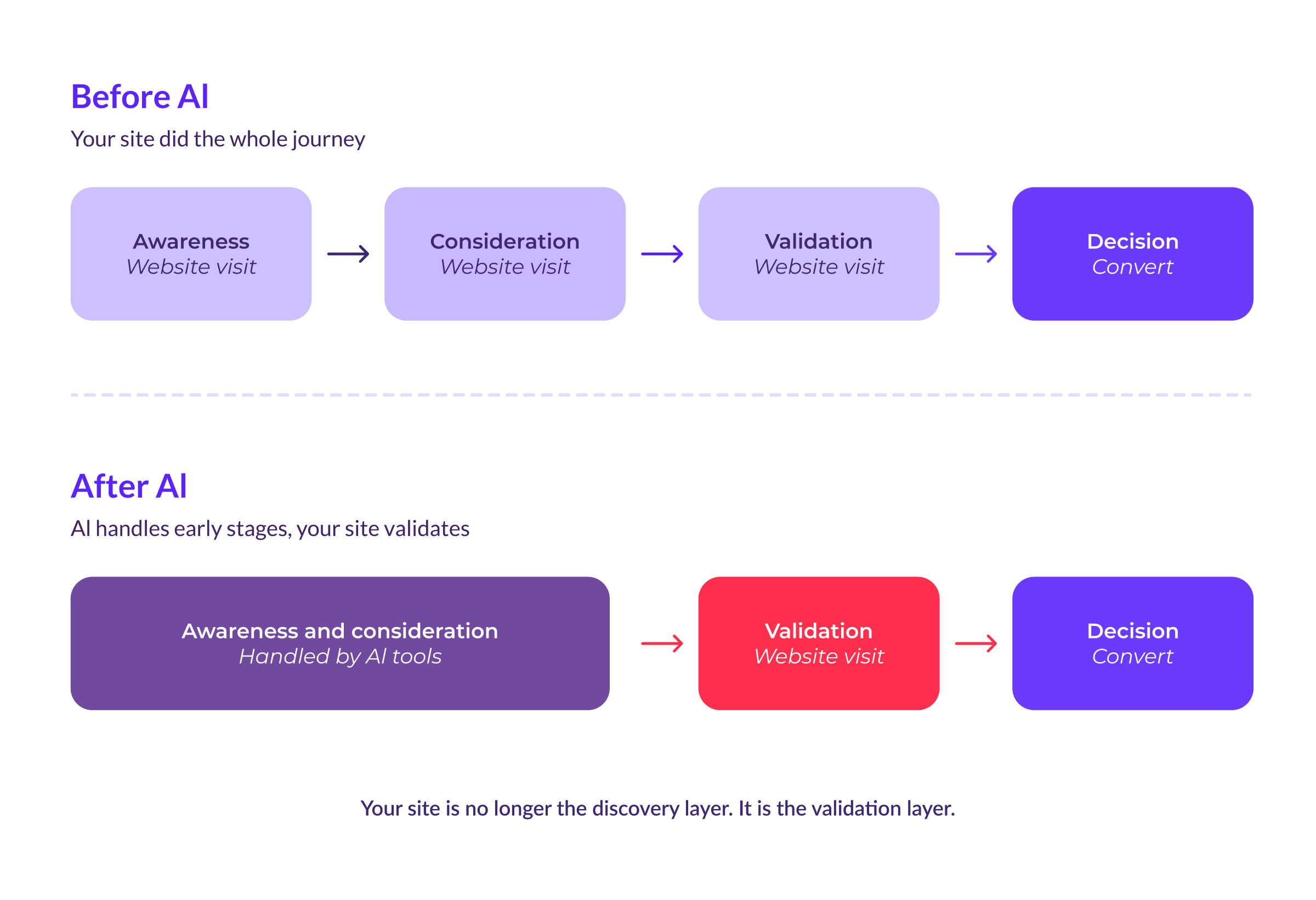
AI tools like ChatGPT, Perplexity, and Google's AI Mode now handle a lot of the awareness and consideration work for buyers. By the time someone lands on your site, they've already been briefed on your category, compared you to competitors, and formed an opinion about whether you're worth a closer look. Recent UX research shows people use AI to explore and synthesize, then turn to trusted websites to verify the things that matter.
What this means for your site is a change in job description. It's no longer the discovery layer. It's the validation layer, the place where pre-qualified visitors confirm what AI already told them and decide whether to take the next step. Brands that understand this shift are getting cited and chosen. The ones that don't are getting skipped.
Here's what the compressed funnel means for your content strategy, how to become the source AI pulls from, and how to rethink conversion for visitors who already know who you are.
Why Traffic Is Down but Performance Can Still Be Up
Let's start with the anxiety most marketing teams are feeling right now. Sessions are down, AI summaries are eating clicks, and the usual dashboards look rough. Leadership is asking questions nobody has good answers for.
Here's the reframe: declining traffic isn't the failure mode. Treating the visitors you still get like top-of-funnel browsers is.
You'll Get Fewer Visitors, but Better Ones
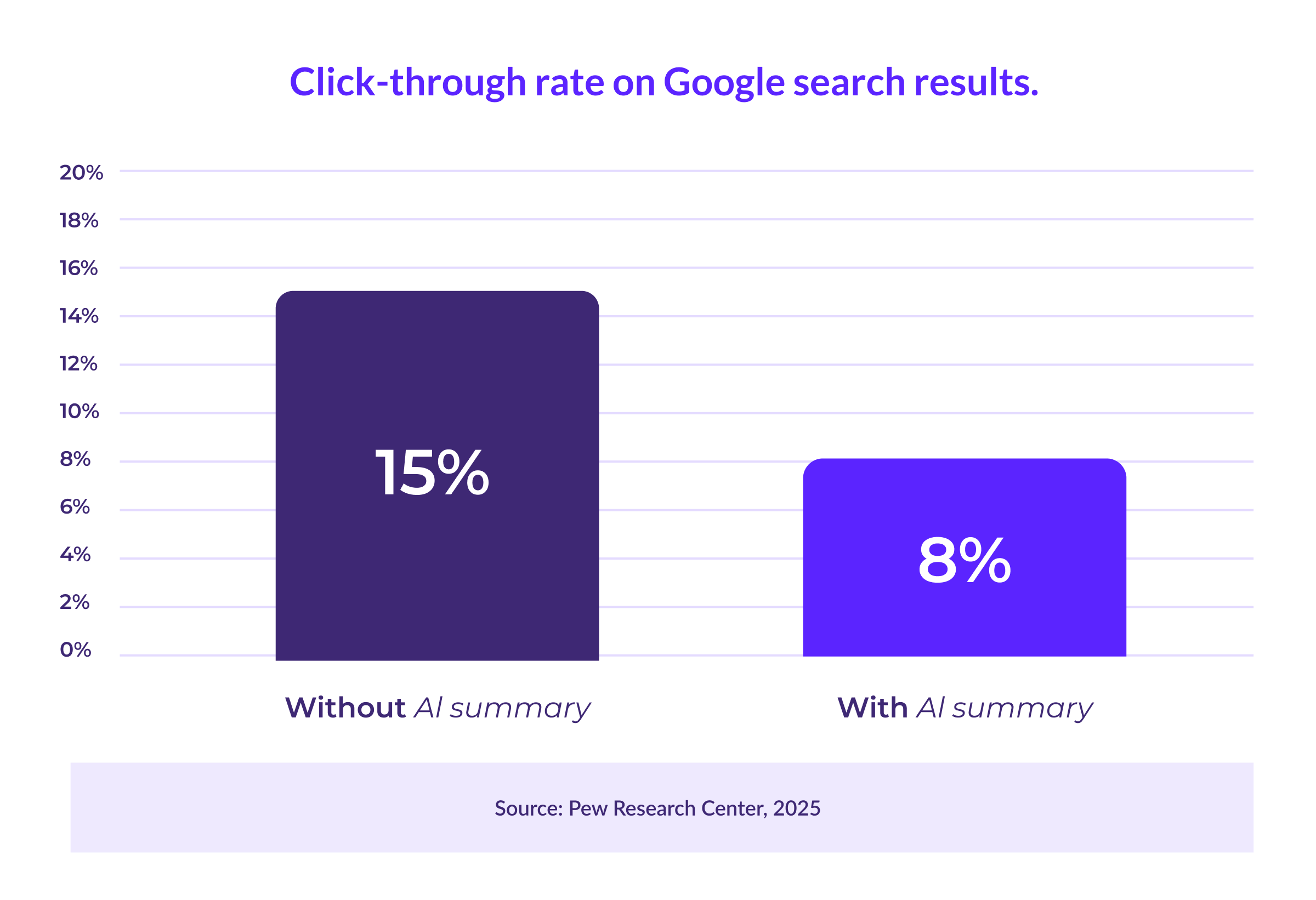
On Google specifically, click rates drop by nearly half when an AI summary appears, from 15% on traditional results pages to 8% when the summary is there. That's a real shift that likely isn’t reversing.
The visitors who still arrive behave differently, though. Bounce rates go down. Time on page goes up. Conversion rates tend to be stronger than what you'd see from traditional organic traffic. When we look at client analytics, AI-referred users tend to behave a lot like high-quality organic, just more engaged throughout. Fewer people are showing up, but the ones who do are closer to making a decision.
That changes what success looks like. Optimizing for volume made sense when your site was the research destination. Now it's the proof point, and the job is to engineer for intent rather than chase sessions.
Stop Tracking Rankings. Start Tracking Mentions.
If traditional ranking matters less because the click isn't happening, what do you measure instead? Visibility. Specifically, whether your brand shows up inside AI-generated answers when someone asks a question in your space.
That means tracking mentions, citations, and brand references inside tools like ChatGPT and Perplexity alongside your usual search reporting. It also means asking different questions in your marketing team meetings. Instead of "where do we rank for this keyword," the more useful question is "are we the brand AI recommends when someone asks about this problem?" AI search engine optimization is part of a broader shift, and the new acronyms reshaping how marketers think about search all point in the same direction.
How to Get Your Content Cited by AI
Getting mentioned in AI answers comes down to whether your content is easy for AI models to trust, parse, and pull from. Three things matter most.
Show Who Wrote Your Content and Why They're Credible
Most corporate content is published anonymously. No author, no bio, no credentials. For AI models trying to decide whether a source is trustworthy, that's a missed signal.
Start by displaying author names on every post. Add short bios with real credentials. Where it exists, link out to LinkedIn profiles, professional associations, or published work. These are small, cheap changes that most content teams haven't made yet, and they tell AI tools your content came from someone who knows what they're talking about.
Make Your Content Easy for AI to Read
Large language models calculate probabilistic relationships between pieces of information, which means they reward content they can parse cleanly. Dense walls of text force them to guess, while clean structure gives them something to work with.
In practice, this looks like:
- Clear H1s, H2s, and H3s that match the actual question the reader is asking
- Short summary paragraphs near the top of each section
- Bullet lists where the information is genuinely a list, not just a way to break up the page
- Concrete answers placed close to the question they resolve
The opposite is the "blob body field" problem we see on a lot of Drupal sites. A valuable page lives as one undifferentiated text field with no internal structure, and AI tools quietly pass it over in favor of something more parseable. Beyond headings and bullets, structured data gives AI tools explicit signals about what your content means, who wrote it, and how it relates to other things on your site.
Write Paragraphs That Can Stand on Their Own
Content that gets pulled into AI responses tends to share a pattern. It contains specific claims, verified numbers, clear definitions, or direct answers that can stand on their own. A paragraph that says "we help organizations improve their digital presence" isn't going to get cited. A paragraph that says "universities using structured content models see 30% higher engagement on program pages" might.
Here's a practical test: can a single paragraph from your page stand alone as an answer to a real question? If yes, you've got a linkable nugget. If the paragraph only makes sense in the context of the five paragraphs around it, you probably don't.
Why Keywords Alone Won't Cut It Anymore
The deeper change happening underneath all of this is the move from keywords to entities. AI and SEO strategies used to work hand in hand on exact-match terms, but that relationship is changing. Here's what it means in practice.
AI Cares About Meaning, Not Exact Words
For years, SEO was about matching strings. Someone types "drupal agency vancouver," and you'd want your page to contain those words in the right places so the algorithm could connect the dots. AI models don't work like that. They work on meaning, which they build from how entities relate to each other.
An entity is anything important on your site: a program, a service, a product, a person, a location. What AI models want to know is who or what the entity is, what its attributes are, and how it connects to everything else. When those relationships are clear, your brand becomes a well-defined node in the model's understanding of your industry. When they're vague, you're just one more page of text competing for attention.
Map the Full Set of Questions Your Buyers Ask
A single keyword is never the full picture of what someone is asking. When a buyer is evaluating a new CMS, they're not typing one thing into ChatGPT. Over a few conversations, they'll ask a dozen related questions: what platforms do enterprise universities use, which ones handle complex content models, what does implementation cost, who has good case studies, what are the common pitfalls.
Your content strategy needs to cover that whole cluster, not just the headline query. Keywords still matter as part of the picture, and adapting your keyword strategy without throwing it out is the right move. The real shift is treating keywords as one input into a broader map of buyer questions rather than the map itself.
How to Convert Visitors Who Already Did Their Research
When someone lands on your site after talking to ChatGPT about solutions in your space, they're not starting from zero. They arrive with context, with comparisons in their head, and with expectations already set. AI conversion rate optimization is about meeting them where they are, not where your old funnel assumed they'd be.
AI-Informed Visitors Won't Wait Around for Clarity
AI-informed visitors have already seen the high-level landscape. They know roughly what things cost, how your category works, and what your competitors claim. That means they've got less patience for vague marketing copy, hidden pricing, and generic positioning. If they can't quickly confirm that you do the thing they came to verify, they'll bounce back to the AI tool and ask for a different recommendation.
The fix is clarity. Specific claims over generic ones. Real numbers where you can share them. Transparent pricing or at least a clear range. Social proof that matches the buyer you want to attract. Every friction point is an invitation to leave.
Give People Both Easy and Serious Ways to Convert
Decision-ready visitors want fast paths to the thing they came for. Demo requests, direct contact with a human, pricing conversations. Give them obvious routes to those, and don't bury them behind three form fields.
Not everyone is ready at the same moment, though. Some visitors are still validating, and for them, pair the high-commitment options with lower-barrier ones like a case study download, a short explainer video, or a relevant blog post. The goal is meeting people where they are in their decision rather than forcing everyone through the same funnel.
How to Track Whether Your AI Strategy Is Working
You can't improve what you can't see. Most teams still have no visibility into how AI traffic is behaving on their site, which makes every conversation about AI strategy feel vague and theoretical.
Track Visitors Coming from ChatGPT, Perplexity, and AI Mode
Start with Google Analytics. Using Google Tag Manager and a bit of regex configuration, you can identify visits coming from ChatGPT, Perplexity, Claude, and Google AI Mode, then watch how those visitors behave compared to your other traffic. Any competent digital marketer can set this up in an afternoon, and it gives you a baseline before you start claiming any AI strategy is working.
Focus on How Visitors Behave, Not How Many Show Up
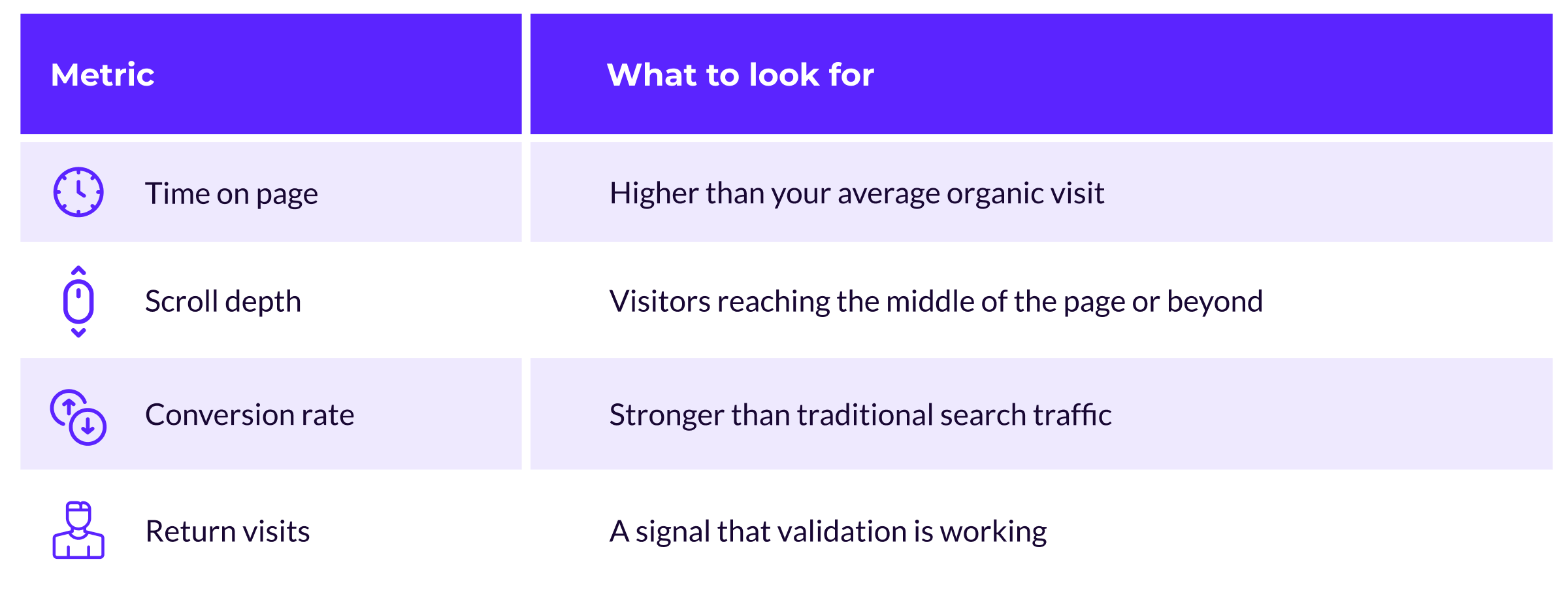
Once the tracking is in place, pay attention to the right metrics. Volume is going to look worse than it used to, and that's fine. What you want to see instead:
Tools like Semrush, Ahrefs, and Moz are all rolling out AI visibility tracking as a standard feature. Pick one and start building a baseline now. Teams that have six months of data when leadership finally asks about AI performance will be in a much better position than the ones scrambling to retrofit measurement.
Three Things to Do This Month
Don't try to do all of this at once. The teams making real progress are picking two or three high-leverage moves and building from there.
A reasonable starting list looks something like this:
- Pick your top three highest-intent pages and restructure them for citation readiness
- Set up GA4 tracking for AI referral traffic so you have a baseline
- Audit one of your most important entities and make sure its page clearly defines what it is, what it does, and how it relates to the rest of your site
That's enough to move the needle without overwhelming a team that's already stretched thin. A smart AI business strategy isn't waiting for anyone to catch up, and small, deliberate changes compound fast.
For a deeper walkthrough, the ImageX team recently ran a webinar in partnership with Search Engine Journal called Drupal AI Audit: How CMOs Can Assess Whether Their Stack Is Built for What's Coming, covering citation readiness, the shift from keywords to entities, and how to convert AI-informed visitors. You can watch the full recording at your own pace.
Contributors