
What are Synthetic Personas and Why Should Marketers Care?

Most marketing teams have invested real time and budget into building personas, and the research behind them is usually solid. Interviews, survey data, and behavioural analytics all capture something true about your audience at a specific point in time.
The problem is buying behaviour shifts as markets change, new competitors emerge, and economic conditions evolve. A persona built from last year's research can't tell you how your audience would respond to a campaign concept you developed this morning, and updating it means going back through the same expensive research cycle that produced it in the first place.
There's an emerging approach to this problem that's gaining serious traction with marketing research teams, and they’re called synthetic personas.
Let’s break down what they are, how they work, why the timing matters, and how to think about using them without overestimating what they can do.
- What Are Synthetic Personas?
- Why Synthetic Personas Matter for Data-Driven Marketing Right Now
- How Marketers Can Use Synthetic Personas
- The Limitations of AI Personas You Need to Know
- How to Start Using Synthetic Personas Responsibly
Where AI in Marketing Research Is Headed
What Are Synthetic Personas?
A synthetic persona is an AI-generated profile designed to simulate how a specific audience segment thinks, feels, and behaves. Rather than being invented from assumptions, these profiles are built from data: CRM records, web analytics, past survey responses, purchase histories, and market research.
You can pose questions to a synthetic persona about how they'd react to a piece of messaging, whether a content topic would interest them, or what objections they might raise about your product positioning. The model generates responses grounded in the data it was trained on, giving you a way to stress-test ideas before they reach real audiences.
How AI Personas Are Built from Real Data
The inputs will look familiar to most marketing teams:
- Web analytics and on-site behaviour
- CRM history and purchase patterns
- Past survey responses and interview transcripts
- Social media behaviour and sentiment data
- Competitor intelligence and market context
- Demographics and firmographics
The AI identifies patterns across these sources and generates profiles that reflect how real segments behave, essentially building a composite from thousands of data points rather than a handful of interviews.
What matters most is the quality of what goes in. If a model is trained on clean, well-structured first-party data, it can produce genuinely useful outputs. While a model built on incomplete or outdated datasets will generate responses that sound plausible but don't map to how your audience behaves. And because the outputs are articulate and well-formatted, it's easy to mistake them for reliable insights when they aren't.
How Synthetic Personas Differ from Traditional Customer Personas
Traditional personas are static by design since they capture who your audience is at a specific moment, staying that way until someone commissions new research. They're valuable for team alignment and empathy-building, but struggle to adapt when conditions change.
Synthetic personas are dynamic and scalable because they can be queried on demand, refreshed as new data flows in, and extended to cover new segments without rebuilding from scratch.
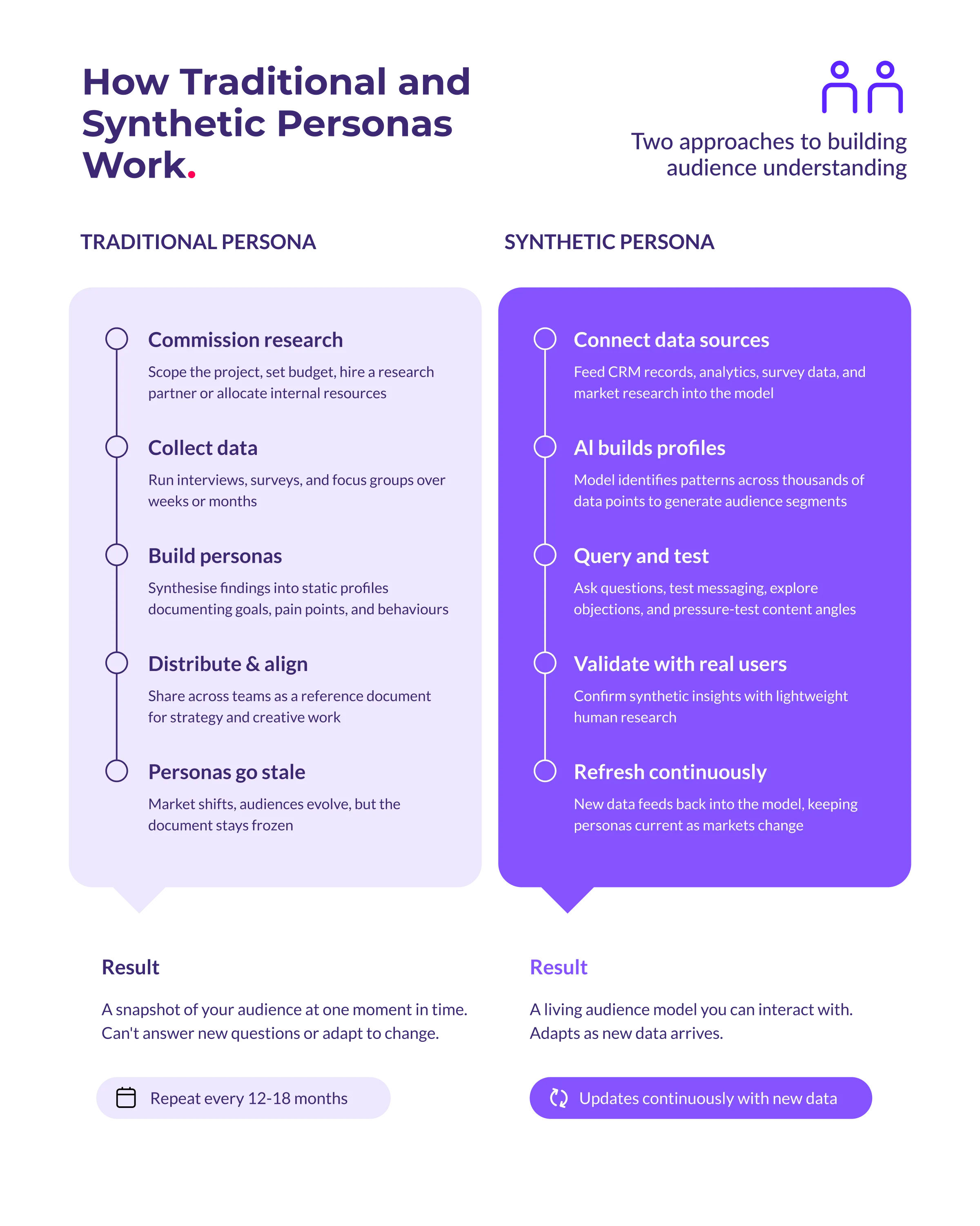
The key distinction is that traditional personas reflect what your team believed about the audience at one point in time, while synthetic personas let you continuously test whether those beliefs still hold.
Why Synthetic Personas Matter for Data-Driven Marketing Right Now
Three pressures are converging that make this topic relevant today rather than theoretical.
- Modern marketing demands faster feedback than traditional research timelines allow
- Niche audiences, especially senior B2B decision-makers, are difficult to recruit for traditional research
- Privacy regulations are raising the complexity of direct data collection every year
The adoption numbers reflect the momentum with 71% of market researchers expect synthetic responses to make up more than half of data collection within three years, and among those who've already used them, 87% report satisfaction with the results.
Faster Feedback Loops for Campaign and Content Decisions
Traditional marketing research has gotten faster in many ways. AI can help design surveys, analyse results, and generate reports in a fraction of the time it used to take. The bottleneck that remains is human participation. Recruiting the right respondents, waiting for enough responses, and scheduling follow-up interviews still takes weeks or months, and campaign timelines don't always wait.
Early results suggest synthetic research can deliver comparable insights in half the time at a third of the cost when layered on top of existing customer data. In the early stages of campaign development that speed advantage matters when you need directional signals rather than statistically perfect data.
Reaching Audiences That Are Hard to Survey
Some segments are expensive or logistically difficult to access through traditional methods. Niche B2B decision-makers rarely respond to cold survey invitations, and international audiences introduce layers of translation and cultural nuance that drive up both cost and complexity. Even domestically, recruiting a representative panel for certain demographics can take months of lead time and significant budget.
Synthetic personas let you explore how these groups might respond to messaging or content strategy without assembling a live panel for every question, which is particularly useful when you're entering a new market and need a more informed hypothesis before investing in a full research effort.
Privacy-First Marketing Research in a Post-Cookie World
Third-party cookies are disappearing, regulations like GDPR and CCPA keep expanding, and consumers are paying closer attention to how their data gets used.
Since synthetic personas work from patterns in aggregated data rather than individual records, the compliance burden can be reduced compared to traditional collection methods.
This doesn't eliminate privacy considerations entirely, since the training data still needs to be ethically sourced, but it gives marketing teams a way to generate audience insights without adding to their personal data footprint.
How Marketers Can Use Synthetic Personas
The most practical applications map directly to activities marketing teams already do. You don't need a data science department or custom machine learning infrastructure to get value here.
Test Messaging and Creative Before You Spend
Before committing media budget to a set of ad concepts or email subject lines, you can run them past a synthetic persona representing your target segment and get directional feedback on which angles resonate and which fall flat.
This doesn't replace A/B testing with real audiences. It filters out weaker ideas earlier so you're only spending real dollars on your strongest contenders.
Explore New Audience Segments Without Starting from Scratch
When expanding into a new vertical or targeting an unfamiliar demographic, synthetic personas give you a starting hypothesis. You can model how a prospective segment might react to your value proposition, surface objections you hadn't considered, and refine your approach before committing to a full research cycle.
Once you have a clearer picture of how different segments think, you can start tailoring your web content to match their needs and motivations. The synthetic persona provides insight and personalisation translates it into experience.
Pressure-Test Your Content Strategy
You can also use synthetic personas to gut-check your content roadmap. Share your planned blog topics, resource themes, or campaign angles with a persona representing your target audience and ask whether these topics match how they think about their challenges, or whether they reflect how your internal team frames things.
It's a fast way to catch misalignment between what you're planning to publish and what your audience would find useful.
The Limitations of AI Personas You Need to Know
Synthetic personas have real limitations, and understanding them upfront is essential to using the tool responsibly.
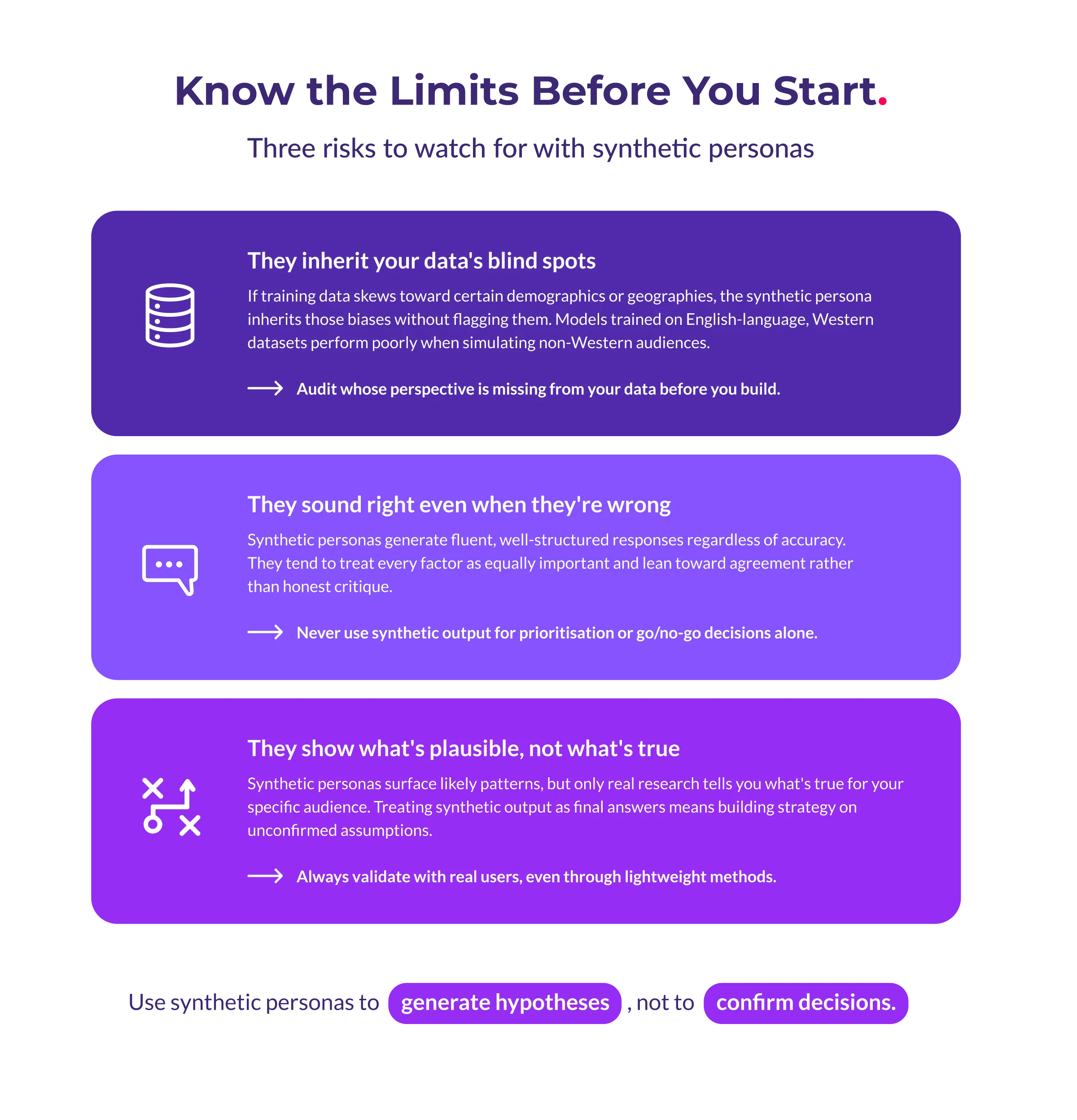
They Reflect the Biases in the Data They're Trained On
If the data feeding the model skews toward certain demographics, geographies, or behavioural patterns, the synthetic persona will inherit those same blind spots without flagging them.
This is a well-documented problem, not a theoretical one. AI models trained primarily on English-language, Western datasets perform significantly worse when simulating non-Western audiences, which means marketers using synthetic personas to inform campaigns targeting diverse or international segments need to scrutinise the training data carefully and ask whose perspective is missing.
They Sound Convincing Even When They're Wrong
Synthetic personas generate articulate, well-structured responses regardless of whether the underlying insight is accurate and that creates a trap around prioritisation.
Independent testing found that synthetic users tend to care about everything equally rather than prioritising the way real people do.
Real audiences have strong opinions about what matters most and what they'd trade off. Synthetic personas present every factor as roughly equally important, which makes them unreliable for decisions that require ranking.
They also lean toward agreement rather than honest critique. If you're looking for someone to push back on a weak concept, you'll need real people for that.
They Don't Replace Real Audience Intelligence
It’s important to remember that only real research tells you what's true for your specific audience. Synthetic personas surface what's plausible.
They're best positioned as a tool for generating hypotheses, narrowing options, and identifying blind spots early in the process. The insights should then be validated with actual humans, even through lightweight methods like a short survey or a few customer conversations. Organisations that skip that validation step and treat synthetic outputs as final answers risk building strategy on assumptions that were never confirmed.
How to Start Using Synthetic Personas Responsibly
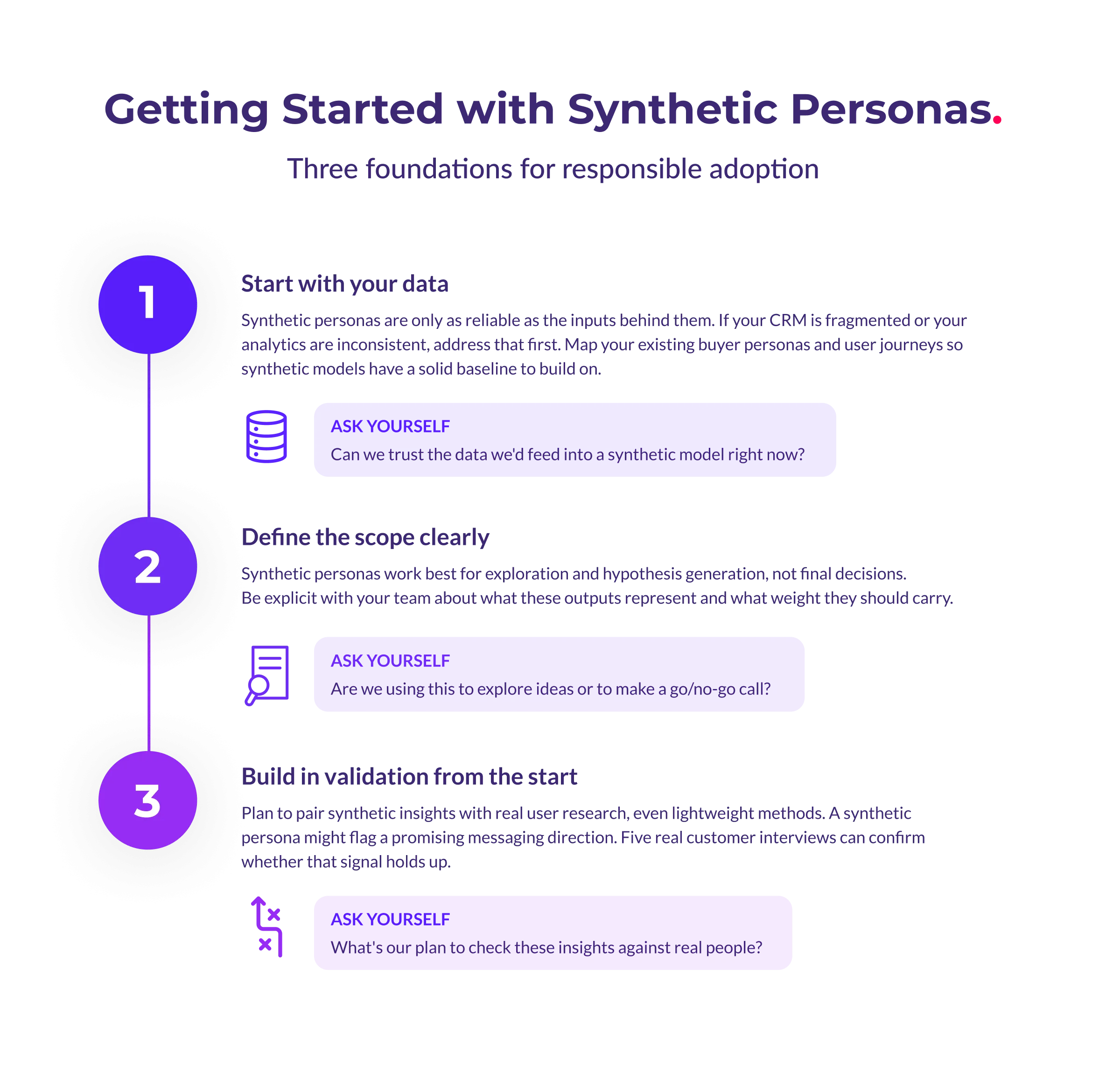
If you're considering bringing synthetic personas into your workflow, three foundations will set you up well.
Where AI in Marketing Research Is Headed
Synthetic personas are one part of a broader shift in how marketers build audience understanding. The models will keep improving as training data gets richer and more representative, the tools will become more accessible, and the line between synthetic and traditional research methods will blur as organisations learn to integrate both.
The marketers who benefit most from this tool will be the ones who develop the discipline to use AI-generated insights as a complement to human understanding rather than a substitute for it. If you're exploring how AI is already shaping broader marketing practice, our guide on how it's transforming SEO and content decisions is a practical place to start.
Contributors