Celebrating Women in STEM: How Three Members of Our Team Found Their Way to Tech
February 11 marks the International Day of Women and Girls in Science. This year's theme, "Synergizing AI, Social Science, STEM and Finance: Building Inclusive Futures for Women and Girls," highlights how critical diverse perspectives are as technology impacts every industry.
Globally, women are more likely than men to pursue higher education, yet they make up only 35% of science graduates. In artificial intelligence, only one in five professionals identifies as female. Software development sits at 20.3% women. Web and digital interface design fares better at 47.5%, but the gap across STEM fields remains wide, with women holding less than 30% of professional STEM roles overall.
These statistics describe an industry, not people. So we asked three of our team to share how they got into technology, what surprised them, and what insights they would like to share with the next generation.
Three different paths into technology
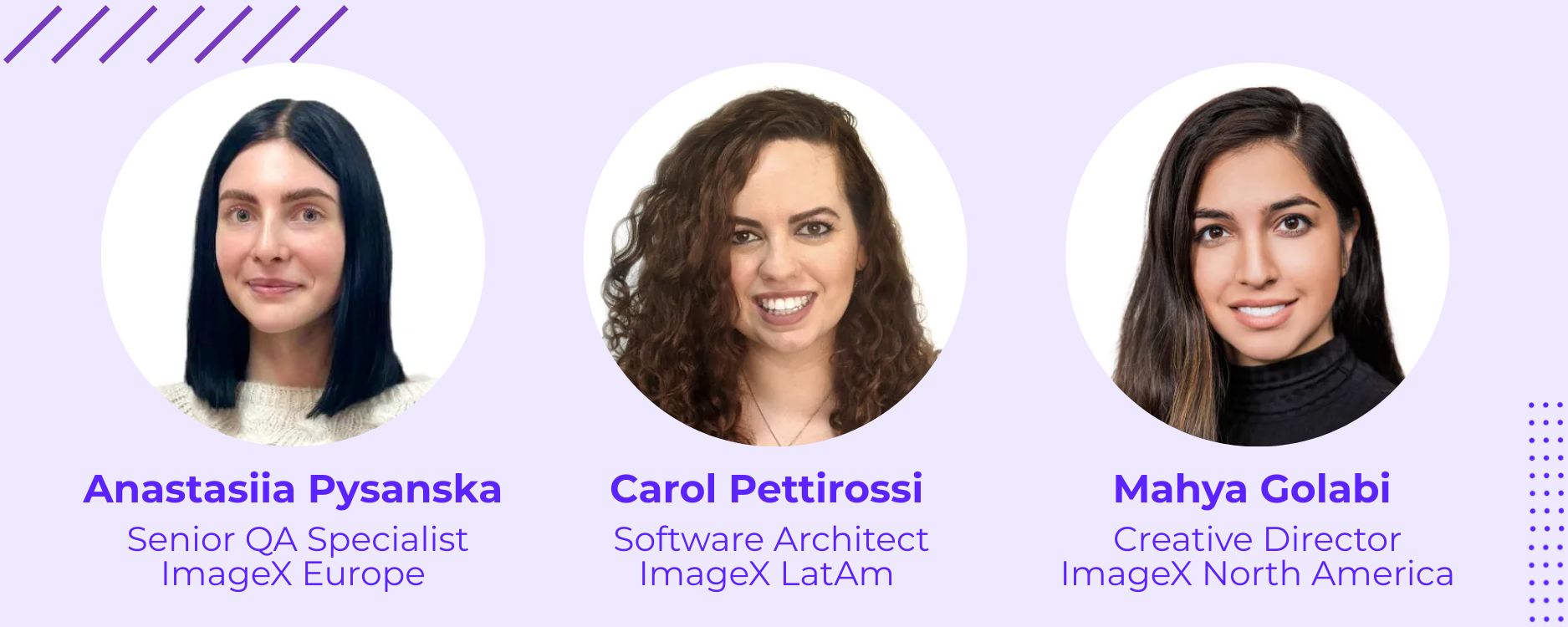
None of them took a straight path.
Carol's first brush with technology came at 12, customizing blog templates. She wanted a gothic aesthetic, black backgrounds, mouse trail effects. "Very dark and very gothic," she says. At that age, she wasn't thinking about a career in tech. She wanted to be a doctor.
The financial reality of medical school in Brazil changed that. Six years of university, plus a specialty, plus the cost, all requiring a level of support she didn't have. "I started looking into more practical options," Carol explains. "I figured I could earn some money in technology and build from there."
She enrolled in a technical course but didn't connect with it. An internship requirement led her to a company where she started working with Drupal, and that changed everything. "I found it so cool. I could build things so much faster than what I was learning in class, and I could actually relate what I was building to my daily life." That spark kept her on the path she is on today, and she has never looked back.
Mahya's path started with an instinct for design that showed up early. She was particular about outfit colors as a kid, refusing to leave the house if the shades didn't match. But in Iran, university placement depends on a national exam, not personal preference. She spent two years studying business management before recognizing it wasn't for her.
After moving to South Africa in 2010, she pursued graphic design. Years later, when she moved to Canada in 2017, her husband, a software developer, encouraged her to push further into digital design and UX. "He really encouraged me to move from a less digital way of expressing design into something more in the tech space," she says.
Anastasiia studied geology. In her final year at university, she learned programming tools for geophysics measurements. Many of her male classmates moved into IT after graduation. She spoke with them, got curious, but the real turning point came during the COVID-19 lockdown. That period of reflection made her realize she wanted a meaningful career in tech. She committed to upskilling and discovered something that resonated.
"What really interested me was making sure things work properly and having an impact on things that people use every day," she says. QA offered something else she valued: constant learning. "It's very dynamic. A lot of new things appear each year, and your work inspires you to learn new technologies."
Three different regions with three different starting points, but one common thread: curiosity won over convention.
The reality of being a woman in a male-dominated field
At 14, Carol wanted to take a technical course in electronics, a focused program designed to prepare students for work by 18. Her dad worried about bullying in such a male-dominated field and pushed her toward something else. She pivoted to a technical course in informatics instead, But he didn't realize that field would be male-dominated too.
In Carol's year, the class split evenly between men and women. "Everyone was like, “this is incredible. It's changing”." However, it was the only year that happened. By 18, she'd joined her first company and was working full days while attending university for computer science at night, 7 to 11 PM, for five years straight.
When Carol entered the workforce, the pattern became clear. If you are a woman, you are steered toward roles considered less technical. "People kept saying I'd be a great project manager. But I didn't want that. I wanted to stay on this path and be a great coder, a great architect."
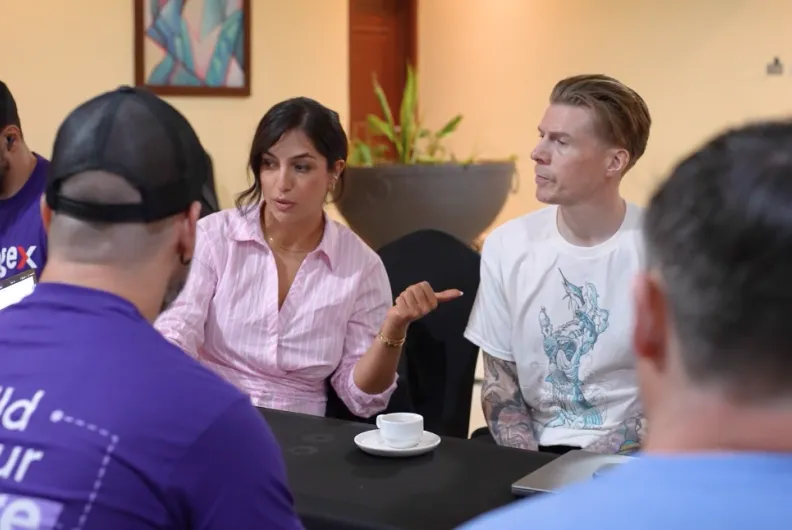
Mahya's initiation was equally direct. After finishing graphic design, her first job placed her as the only designer working alongside 25 male developers.
"I would have meetings with them and they didn't listen to me," she recalls. "They didn't think I knew anything." It took months of standing her ground, learning enough development language to push back on technical objections, and fighting for design decisions on every project. "It taught me a huge amount," she says. "Because I knew where I stood."
Anastasiia faced a quieter version of the same challenge. Starting in IT, she battled imposter syndrome. "I kept thinking everyone would assume I'm stupid because I'm a girl. We often face that, especially in technical areas." But where Carol and Mahya pushed back against external resistance, Anastasiia's battle was mostly with herself.
She describes herself as naturally motivated, someone driven less by proving others wrong and more by the personal satisfaction of meeting her own goals. That internal discipline carried her through the early doubt and into a career she now considers home.
What connects these stories isn't the struggle itself. Women across every industry face versions of this.
What stands out is how each of them responded. Carol and Mahya refused to accept the direction others chose for them. Anastasiia refused to let self-doubt choose for her.
The strengths women bring to technical teams
Ask these three what strengths they bring as women in tech, and the answers circle back to the same territory: communication, empathy, and the ability to separate ego from work.
Carol points to emotional intelligence. "We care about the client. We think about how the other person is going to receive feedback. If you were in their position, how would you take it?"
In her role as a software architect, that awareness shapes how she communicates with developers, project managers, and clients. She doesn't soften the message, she considers how to deliver it so it lands constructively.
Mahya names resilience and audacity. "We just don't have time to waste. You've got to say what you need to say because you need to move on to the next thing." She notes this directness doesn't always land well. When women say no, it reads differently than when men do. "If we say no, it's like, ‘oh, she's rude’. But then if a man says no, it's okay."
Recognizing that double standard doesn't stop her from speaking up. It just means she's aware of the context she's operating in.
Anastasiia describes calmness and sensitivity in how she communicates about technical issues. "Developers have told me I never say 'it's your fault.' I just talk about things in an easy-going way, things that can be easily fixed."
In QA, where the job literally involves finding what went wrong, that approach builds trust instead of defensiveness. "As women, we don't try to make someone feel guilty. We try to come up with a way to make everyone happier."
Mahya adds another observation: women tend to separate their identity from their work product. "We know that you are not your work. Your work is separate from who you are." When a design gets critiqued or code needs revision, they focus on the solution, not the personal slight. "You just want to get to a solution at the end as a team, no matter what."
The role models who made the difference
Behind each of these careers is someone who made the path feel possible.
Carol credits her mother. At 35, with a five-year-old Carol at home, her mom went back to school to become a nurse. She sometimes worked two jobs to make it work. "If she can start when she's 35, why can I just take the easy way?"
Carol also found a mentor in a friend who was further along in his tech career. He was a sounding board during challenging moments. "He'd say, “don't mind this. You don't need to pay attention to that. You're better than this comment”." Having someone she trusted to be honest with her made the difference.
Mahya watched her mother navigate a male-dominated environment long before she faced one herself. Her mom owned and ran a school in Iran, an all-boys school, where she managed male teachers and staff in a culture with strong gender expectations.
"I saw how she was so composed and confident and stood her ground." Mahya also saw the anxiety. "I got both. The anxiety and her strength." That duality shaped her approach: be the boss, but lead with empathy.
Anastasiia's inspiration came from her fiancé, who worked in QA before she did. "I watched him and thought, wow, he looks so happy doing his job, so interested in what he's doing." His example made her want to be part of a team, to communicate and solve things collaboratively. When imposter syndrome crept in, he gave her the confidence she needed. "He gave me the confidence to believe I'm smart, and that if I want something, I will achieve it."
The lesson: mentors don't have to look like you, they only have to believe in you.
Advice for young women considering a career in technology.
We asked each of them what advice they'd give to young women considering a career in technology, or the wider STEM fields.
Carol: "Don't let a stereotype define you. It's just things that people repeat. They don't even believe it sometimes. You are you, and you are unique." She also stresses finding a mentor early. "Someone you can trust. Someone you can ask for advice, or just cry about stuff. It really helps."
Mahya: "All those times you put in that extra hour, that all-nighter, that extra mile, it will all make sense and be worth it. Pain and fear are so temporary. The result of what you get out of it is so much greater."
Anastasiia: "Don't give up without trying. Discipline is the key to success. There's no such thing as 'I can't do it' or 'I can't learn it.' It comes down to how much effort you put in. When you find even 10 or 30 minutes a day to learn something new, you always win."
Why diverse perspectives build better technology
These three voices represent a fraction of the diverse perspectives technology needs. The UNESCO event for International Day of Women and Girls in Science exists because the gap between who builds technology and who technology serves still needs closing. When AI systems are designed predominantly by one demographic, the blind spots compound. When development teams lack diverse perspectives, the products reflect it.
Carol, Mahya, and Anastasiia didn't set out to make a statement. They set out to do work they found meaningful, in fields that challenged them, alongside people who valued what they brought. That's what inclusion looks like when it moves past the statistics and into everyday practice.
The technology industry still has a long way to go, but every team that values different perspectives, every company that creates space for people to contribute fully, moves the whole field forward.
That starts with seeing potential in places others might overlook, including in a 12-year-old customizing a gothic blog template.