Content Marketing for Nonprofits: A Guide to Growing Your Mission Online
- How Content Marketing Is Different for Nonprofits
- Building a Content Strategy for Your Nonprofit
- Types of Content That Work for Nonprofits
- Storytelling: The Engine of Nonprofit Content Marketing
- Making Your Content Accessible and Inclusive
- Getting the Most from Your CMS
- Measuring Your Content Marketing Success
- Ready to Strengthen Your Nonprofit's Digital Presence?
Nonprofits don't have the luxury of selling a product with obvious, immediate benefits. You're asking people to give their time, money, or voice to something bigger than themselves. That's a harder ask, and it means the way you communicate matters more than it does for most organizations.
Content marketing is a way you can bridge that gap. Through blog posts, videos, email newsletters, and stories about your impact, you build the trust and emotional connection that turns a curious visitor into a committed supporter. And the payoff can be huge, monthly giving now accounts for 31% of all online fundraising revenue, and that kind of sustained generosity grows through consistent, meaningful engagement over time.
This guide walks through how to build a content strategy for your nonprofit, which content formats deliver the best results, and how to make storytelling the thread that ties everything together. The principles apply whether you're running content marketing for charities, community organizations, or large-scale NGOs.
How Content Marketing is Different for Nonprofits
Commercial content marketing is built around solving a customer's problem and selling a solution. With nonprofit content marketing, you're inviting people into a cause, and that requires a different kind of relationship with your audience.
For starters, your audiences are fragmented. Donors, volunteers, beneficiaries, board members, and community partners all land on the same website, but they each need different information and different emotional hooks. A first-time visitor looking for proof of impact needs a different experience than a lapsed donor who needs a reason to come back.
Retention is a real challenge since only 19% of first-time donors return to give again. That means most of the people your campaigns worked hard to acquire will disappear without consistent follow-up. Content is how you stay in front of supporters between asks, so when you do reach out with an appeal, they already feel connected to your work.
The donor base is also changing. Millennial giving jumped 22% in 2024, and this generation discovers and evaluates causes online first. If your content doesn't reach them there, your organization doesn't exist to them. Your nonprofit website design and the content on it are often the first and most lasting impression you'll make.
Building a Content Strategy for Your Nonprofit
A strong content strategy starts with three things:
- Knowing who you're talking to
- Setting goals that connect to your mission
- Understanding what you already have to work with
Get these foundations right and every piece of content your team produces will have a clear purpose behind it.
Know Your Audiences
Before you create a single piece of content, get specific about who you're trying to reach. Build personas for each key group: first-time donors, recurring supporters, major gift prospects, volunteers, beneficiaries, and community partners. Map their motivations, what they need from you, and how they find your site.
The process is similar to creating user personas in other industries. The difference for nonprofits is that each audience sits at a different stage of commitment. A potential volunteer wants to see what the experience looks like whereas prospective major donors want proof of financial accountability.
Meeting each group where they are means producing content that speaks directly to their questions and concerns.
Set Goals That Match Your Mission
Every piece of content should tie back to an organizational goal: increasing donations, recruiting volunteers, raising awareness, driving event attendance, or growing your community. The more specific those goals are, the easier they become to measure and achieve.
"Raise awareness" is too vague to act on. "Increase monthly donor signups by 15% this quarter through a blog series on program impact" gives your team something to aim at and track. If you need a starting point, our guide to nonprofit content strategy walks through how to align content priorities with your mission.
Audit What You Already Have
Before creating anything new, take stock of what exists. Which pages get traffic? Which blog posts still drive engagement? What's outdated or factually stale?
Look for content that can be refreshed, repurposed, or combined. A three-year-old impact report might contain stories worth retelling with updated data. An underperforming blog post might just need a better headline and some current stats. Anything with outdated information should either be updated or removed, because stale content erodes the trust you're working so hard to build.
Types of Content That Work for Nonprofits
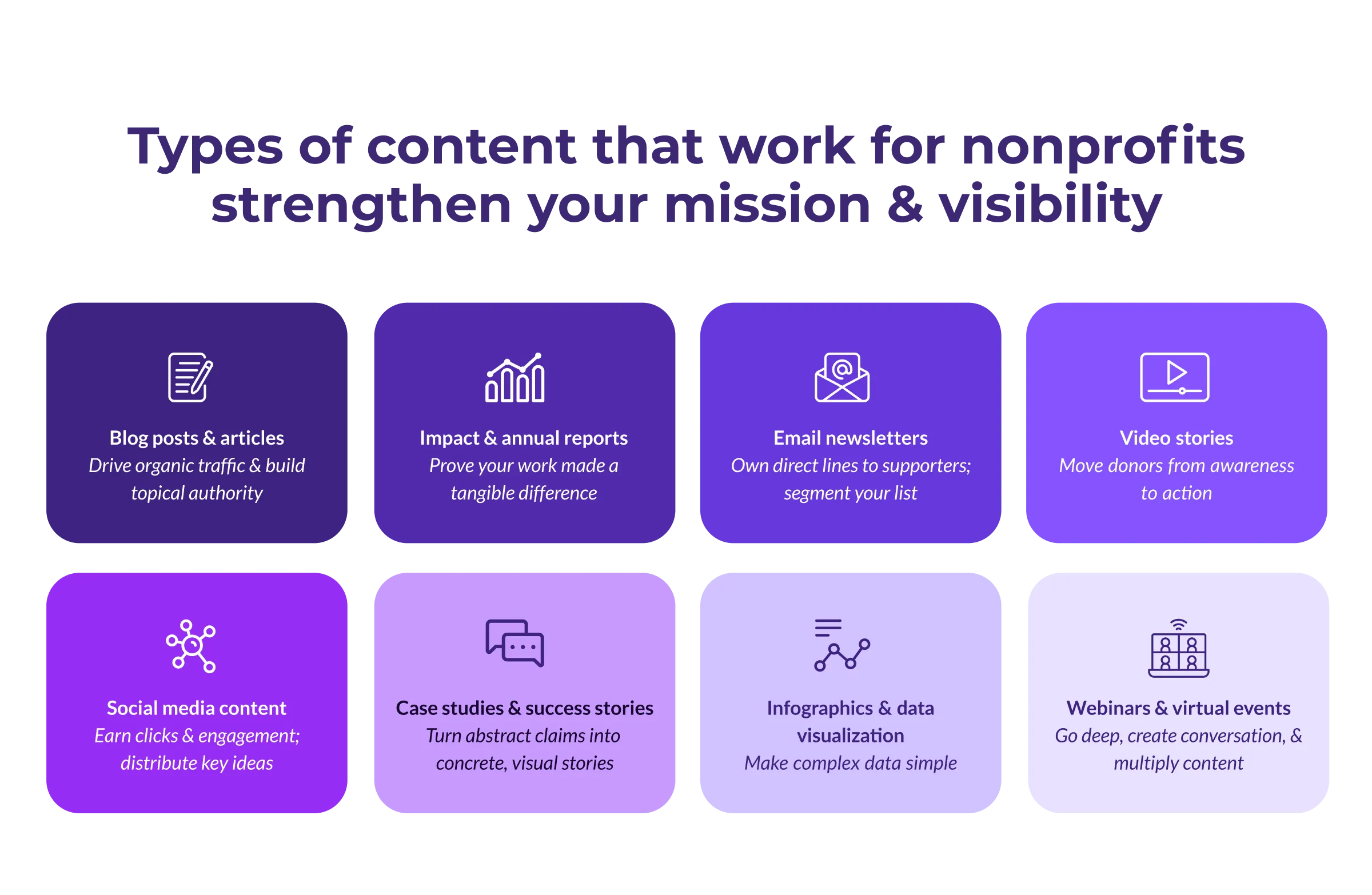
Content creation for nonprofits spans a lot of formats, but not all of them deserve the same investment. Here's where organizations tend to see the strongest returns.
Blog Posts and Articles
Blogging is the workhorse of nonprofit content marketing. Organic search drives 44% of all nonprofit website traffic, and blogs are the primary engine behind that. They build topical authority, give you a steady stream of material to share on social media and in email, and create entry points for people who've never heard of your organization.
Write about what your audience is searching for, not just what your organization wants to announce. Program updates have their place, but so do guides, how-tos, and thought leadership on the issues you address.
Impact and Annual Reports
These are some of the most powerful content a nonprofit produces, and they're often published as a PDF and forgotten. Turn your annual report into web content instead. Pull out the key stories, create standalone data visualizations, and build landing pages around the highlights.
Impact reports serve double duty. They show existing supporters that their contributions made a tangible difference, and they give prospective donors the proof they need before committing.
Email Newsletters
Email remains the most direct line to your supporters. It's the one channel where you own the relationship and don't depend on an algorithm to decide whether your message gets delivered.
Start by segmenting your list. Donors, volunteers, and general subscribers have different interests, and a volunteer doesn't need the same update as a major gift prospect.
Consistency matters more than frequency here. A valuable monthly newsletter that people look forward to opening will always outperform a forgettable weekly one.
Video
Video is the content format most likely to move someone from awareness to action. Nearly three-quarters of donors say they're very likely to give after watching a video about a charity's work, and nonprofits see roughly a $7 return for every $1 spent on video marketing.
You don't need a production crew. A smartphone, decent lighting, and a real person telling a real story will outperform a polished corporate spot with stock footage. Short-form video under two minutes gets significantly higher completion rates. Lead with emotion, keep it tight, and end with a clear call to action.
Social Media Content
Social media works best as a distribution channel and engagement tool, not as your primary content platform. Use it to drive people back to your website, where you control the experience and can capture their information for follow-up.
Organic reach continues to shrink across every major platform, which means your social content needs to earn clicks rather than just impressions. Share the most compelling angle from a blog post rather than summarizing the whole thing. Tease a story rather than telling it all in the caption.
Most importantly, repurpose ruthlessly. A single blog post can become three or four social posts, a short video clip, and an infographic without much additional effort.
Case Studies and Success Stories
Case studies turn abstract claims about impact into something concrete. Instead of saying "we help families in need," a case study walks readers through a specific family's experience: what they were facing, how your program helped, and where they are now.
The best nonprofit case studies follow a simple structure: the challenge, the approach, and the result. A food bank might profile a single mother who used their services during a job transition and is now volunteering there herself.
These stories give prospective donors and volunteers a vivid picture of what their support makes possible, and they're far more persuasive than general statistics on their own.
Infographics and Data Visualization
Nonprofits sit on more compelling data than most organizations realize. Program outcomes, community reach, donation impact, volunteer hours: this information tells a powerful story when you present it visually. Infographics are highly shareable and work well across channels. Embed them in blog posts, feature them in email campaigns, and pull them into your annual report.
Webinars and Virtual Events
Webinars let you go deeper on a topic than a blog post can. They also create a two-way conversation with your audience, which builds trust and community in ways static content can't match.
The real value of webinars is in what comes after. A single session becomes a replay, a blog post summary, a set of social clips, and email content. Few formats give you that kind of return on the time invested.
Storytelling: The Engine of Nonprofit Content Marketing
Every content format listed above works better when it's grounded in a compelling story. Storytelling is what transforms information into connection, and connection is what drives people to act.
Make Your Supporters the Hero
The most common storytelling mistake nonprofits make is centering the organization. "We served 10,000 meals" puts the spotlight on the nonprofit. "Your support provided 10,000 meals" puts the spotlight on the donor and changes everything about how someone feels when they read it.
Effective nonprofit stories position the supporter as the person making the difference. Your organization is the vehicle, not the protagonist. Before writing any story, ask three questions:
- Who is my audience?
- What do they need?
- How does my nonprofit uniquely meet that need?
Use the Cause-and-Effect Framework
The cause-and-effect framework connects a supporter's contribution directly to an outcome. "Your $50 provides a week of meals for a family" is more compelling than "We served 10,000 meals last year" because it makes the chain of impact visible and personal.
Abstract impact statements rarely move people, but concrete, specific ones do. Let donors visualize themselves as the catalyst. Show them what changes because of their involvement, and make that connection as direct as possible.
Weave Stories Across Your Entire Site
Stories shouldn't live on a single "Impact" page. They belong on your homepage, your program pages, your donation forms, and your about page. A donation page with a short beneficiary story converts better than one with just a form. A program page with a volunteer testimonial feels more real than a page with only a description.
Consistency matters too. When someone encounters your story on social media and then clicks through to your website, the tone and narrative should feel like the same organization talking.
Making Your Content Accessible and Inclusive
For nonprofits, accessibility is a direct expression of the values most missions are built on: equity, inclusion, and making sure everyone can access the programs and information they need. Inaccessible content creates barriers for the very people you're trying to serve.
The good news is that most accessibility improvements for content teams are straightforward. Use logical heading structures so screen readers can navigate your pages. Write in plain language. Add descriptive alt text to every image. Provide captions or transcripts for video and audio content. Our guide to content accessibility tips covers the practical details.
You don't have to fix everything at once. Start with your highest-traffic pages, work through them in short, focused sprints, and build accessibility habits into your editorial workflow so new content meets the standard from day one.
Getting the Most From Your CMS
Your content management system can either accelerate your content marketing or quietly sabotage it. If publishing a blog post takes 45 minutes of formatting and workarounds, your team will publish less often and less consistently.
The right platform makes content workflows fast and repeatable. Built-in media libraries, content scheduling, moderation workflows, and WYSIWYG editors let small teams publish confidently without waiting on a developer. Drupal, for example, has a growing ecosystem of modules built for editorial efficiency that can streamline everything from content staging to scheduled publishing.
Don't overlook UX writing as part of your content workflow either. The microcopy across your site, from button labels and form instructions to confirmation messages and error text, guides users through their journey. Good UX writing reduces the friction between "I'm interested" and "I just donated."
Measuring Your Content Marketing Success
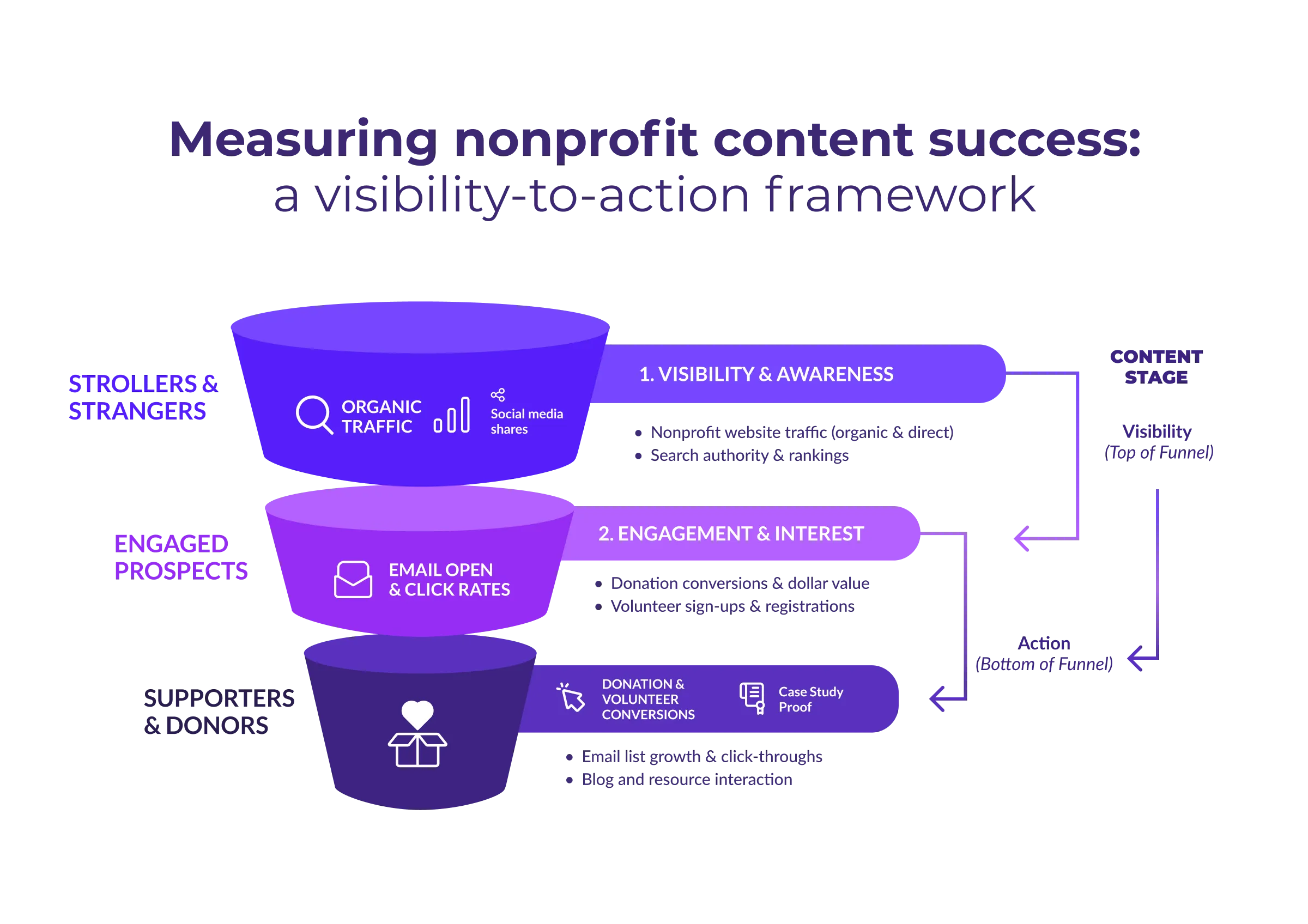
Nonprofit content marketing metrics look different from commercial ones. You're tracking a mix of awareness, engagement, and conversion indicators that together show whether your content is building the audience and trust that drives your mission forward.
The metrics worth watching:
- Organic traffic growth: This shows whether your content is attracting new visitors through search
- Email list growth and engagement: Including open rates and click-through rates that signal how well your newsletters are landing
- Donation page visits and conversion rates: The clearest indicator of whether content is moving people toward giving
- Volunteer signup completions: Particularly from content-driven pathways
- Content-assisted conversions: Which track whether someone read a blog post or watched a video before taking action
Pick three to five metrics that connect directly to your organizational goals and track them consistently. A small team watching the right numbers will outperform a large team drowning in dashboards every time.
Ready to Strengthen Your Nonprofit's Digital Presence?
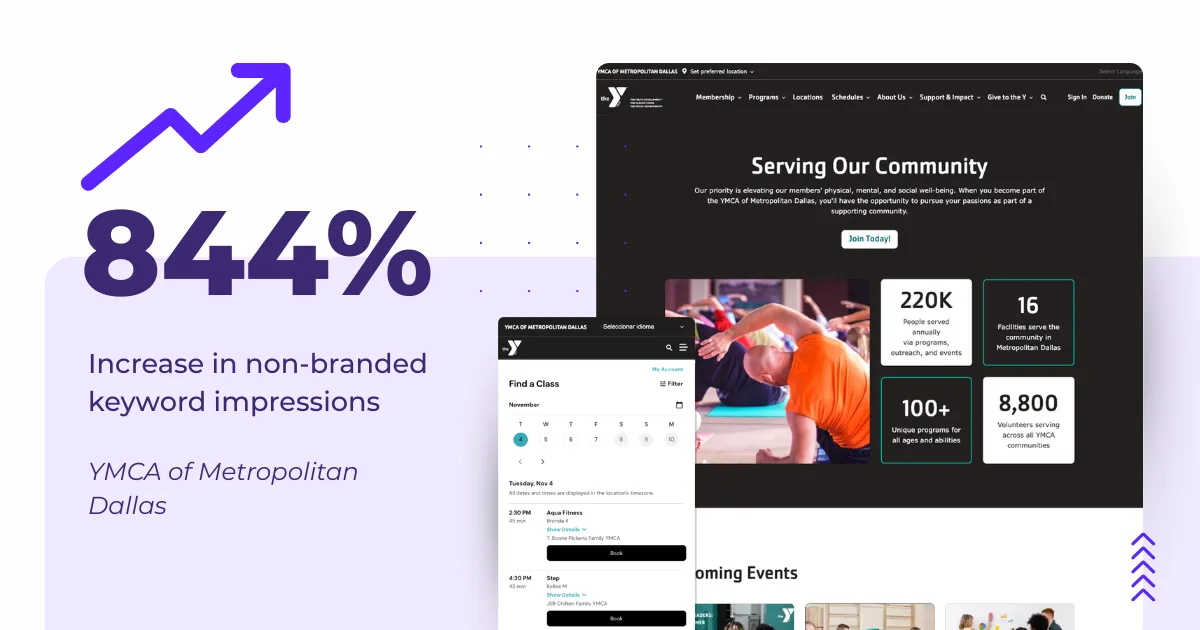
Great content marketing starts with a strong digital foundation. When YMCA of Metropolitan Dallas partnered with us on a targeted content and local SEO strategy, their non-branded keyword impressions jumped from 9,000 to 85,000 and organic transactions increased 36%. If your website, CMS, or content strategy needs that kind of lift, explore our nonprofit services to see how we can help.