
Buried in Technical Debt? How to Move Forward After a Decade of Compromises

- What Is Technical Debt (And Why Should Non-Technical Leaders Care)?
- How Technical Debt Accumulates Over 10+ Years The Warning Signs: How to Recognize Technical Debt in Your Organization
- Why Technical Debt Blocks Your Website Redesign
- Strategies to Reduce Technical Debt
- Why Organizations Choose Drupal to Escape Legacy CMS Challenges
- How to Build a Website Modernization Strategy That Lasts
Someone on your marketing team asks for a simple change to the homepage banner, and the developer tells you it'll take three weeks. You start planning a website redesign, and the scope balloons from six months to eighteen because every estimate keeps uncovering more problems buried underneath.
If any of this sounds familiar, your organization is likely carrying years of technical debt. Not because someone made bad decisions, but because you've been growing and adapting for a long time, and those reasonable trade-offs have quietly compounded into something that now holds you back at every turn.
This article will help you understand what technical debt is, recognize it in your own organization, and map out a realistic path forward. Whether that means incremental cleanup or a full replatforming effort, the goal is the same: stop letting your website's past dictate its future.
What Is Technical Debt (And Why Should Non-Technical Leaders Care)?
Technical debt is a metaphor borrowed from finance. When a development team takes a shortcut to meet a deadline or ships a "good enough" solution instead of the ideal one, they're borrowing against the future. That borrowed time has to be paid back eventually, and the longer it sits, the more expensive the payback becomes.
Every workaround, every "quick fix" that stays in place for years, adds interest that compounds with every future change. A small hack to get a feature out the door in 2016 might now require three developers to work around whenever they touch that part of the site. Multiply that across hundreds of similar decisions over a decade, and you start to see why everything feels so slow and expensive.
The scale of the problem is staggering. Tech debt can represent up to 40 percent of an organization's technology estate before depreciation. For large enterprises, that translates to hundreds of millions of dollars in accumulated shortcuts, deferred maintenance, and architectural compromises.
This matters to marketing leaders, IT directors, Web Managers, and Product Owners because technical debt doesn't stay contained in the codebase. It shows up as missed campaign deadlines, slow page loads that tank your conversion rates, security vulnerabilities that keep your CIO up at night, and redesign budgets that double before the project even kicks off.
How Technical Debt Accumulates Over the Years
No website launches with technical debt. On day one, everything is clean, intentional, and working as designed. But over a decade or more, three types of debt quietly pile up.
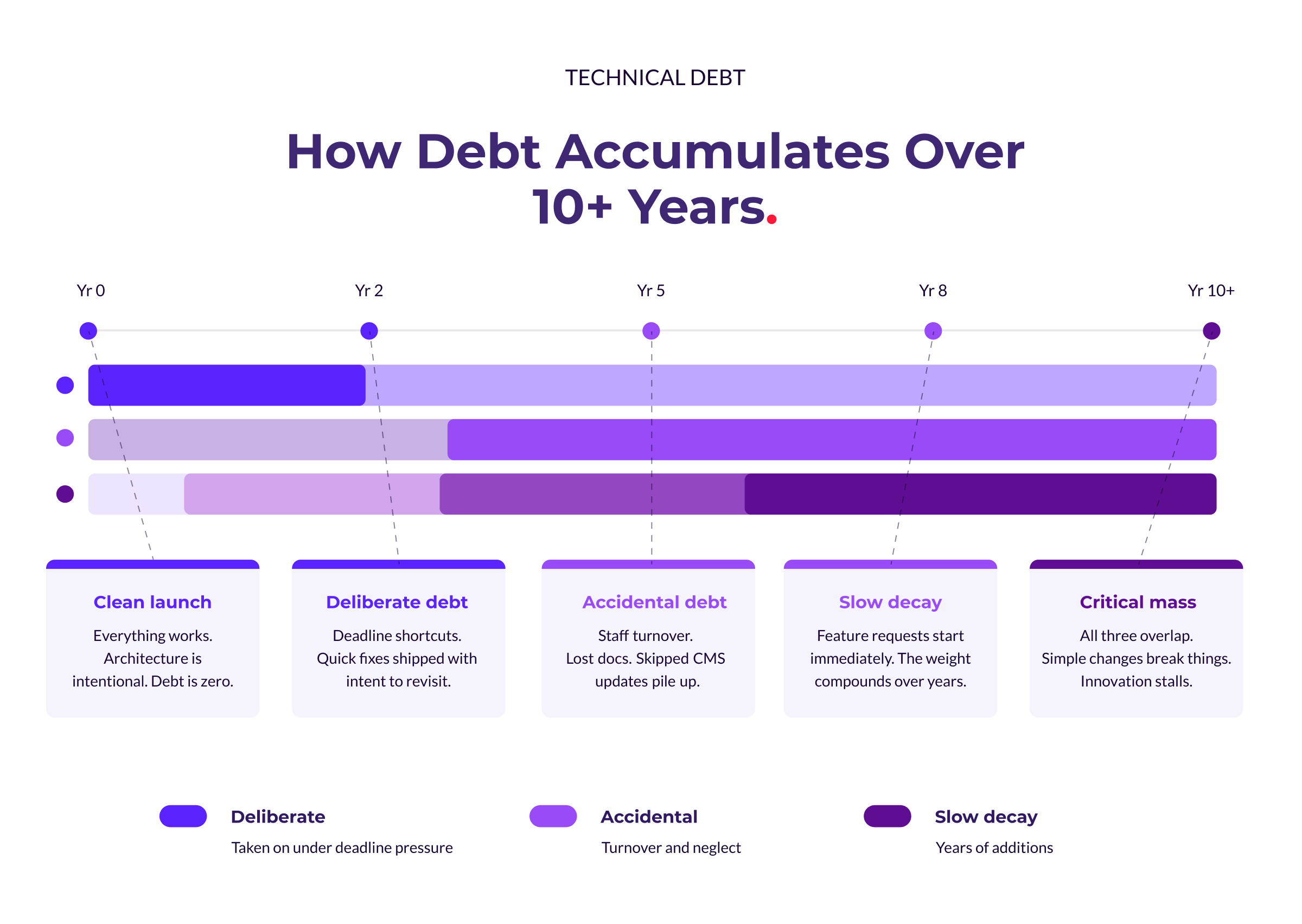
Deliberate Debt: The Shortcuts That Made Sense at the Time
Sometimes you take on debt knowingly. A product launch is two weeks away and the "right" solution would take six, so the team builds a quick version with the understanding that they'll come back and fix it later. That's a reasonable call in the moment. The problem is that "later" rarely comes. New priorities take over, the people who understood the shortcut leave the organization, and the quick fix becomes a permanent fixture that every future project has to work around.
Accidental Debt: What Nobody Saw Coming
This type sneaks in without anyone noticing. Your CMS vendor releases a major update, but your team is too busy with other projects to apply it. A key developer leaves and takes undocumented institutional knowledge with them. Web standards evolve and your site's underlying architecture hasn't kept pace.
None of these are failures of judgment. They're the natural entropy that happens when a complex system operates in a changing environment over many years.
Slow Decay: Death by a Thousand Feature Requests
This is the most common and the hardest to spot while it's happening. Year after year, stakeholders request new features, new integrations, new landing pages. Each one gets bolted onto the existing structure because rebuilding the foundation for every request would be impractical. One plugin becomes ten. Ten custom modules become forty. Three different agencies contribute code over five years, each with their own conventions and standards.
Individually, every addition makes sense. Collectively, they create a Frankenstein architecture that's fragile, slow, and expensive to change.
The Warning Signs: How to Recognize Technical Debt in Your Organization
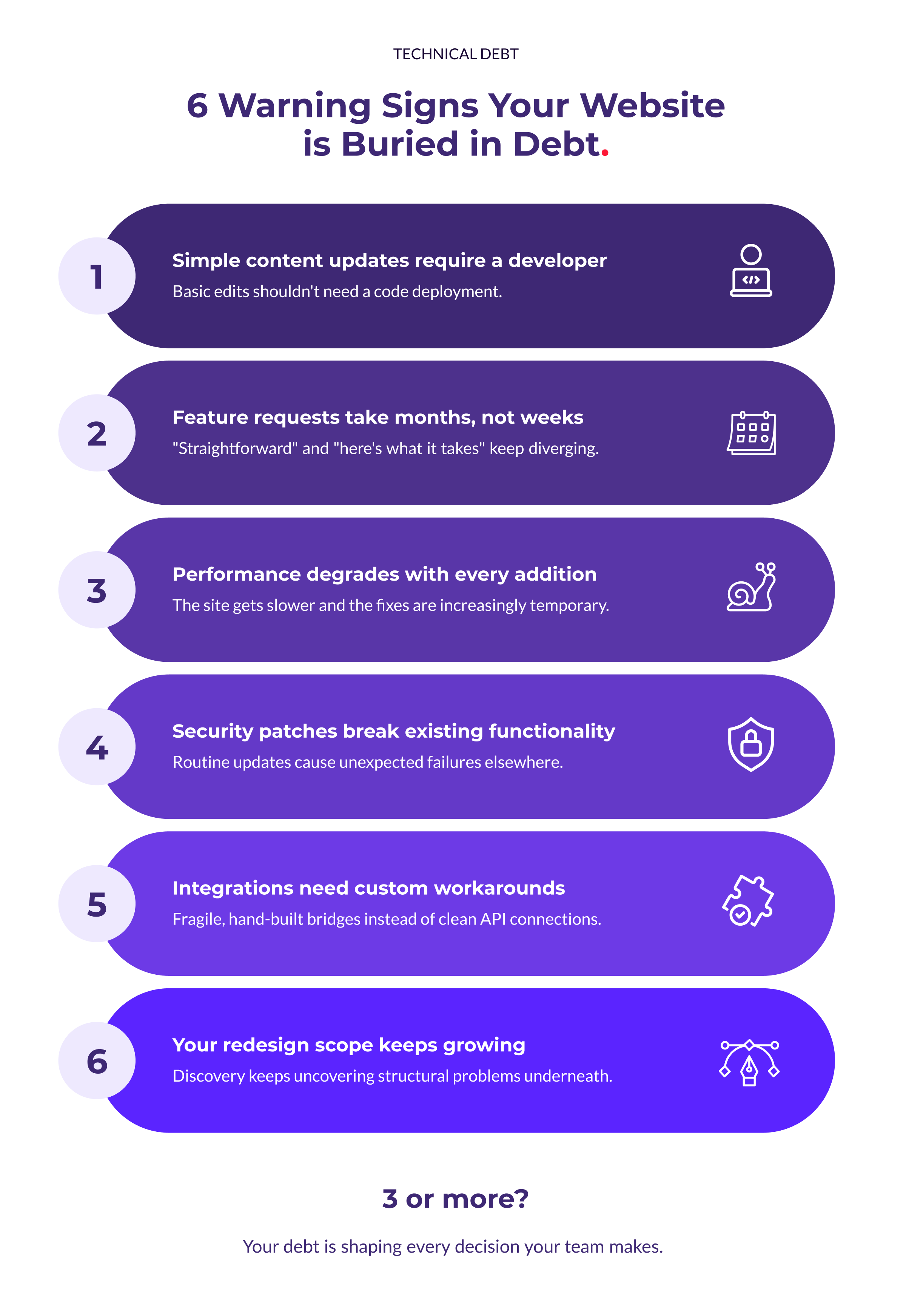
Technical debt rarely announces itself. Instead, it surfaces as a pattern of frustrations that gradually become accepted as "normal." If your team experiences several of these symptoms regularly, debt is likely the underlying cause:
- Simple content updates require a developer: Changing a phone number or swapping an image shouldn't need a code deployment, but your CMS has been customized to the point where editors can't make basic updates without technical help.
- New feature requests take months, not weeks: The gap between "this should be straightforward" and "here's what it will take" keeps widening.
- Performance degrades with every addition: Each new feature or integration makes the whole site a little slower, and the fixes are increasingly temporary.
- Security patches break things: Applying a routine update causes unexpected failures elsewhere because elements are so tightly coupled that touching one thing breaks another.
- Third-party integrations need custom workarounds: Connecting your CMS to your CRM, marketing automation platform, or analytics tools requires fragile, hand-built bridges instead of clean API connections.
- Your redesign scope keeps growing: What started as a visual refresh has ballooned into a full rebuild because the discovery phase keeps uncovering structural problems.
If you're nodding along to three or more of these, the debt has likely reached a point where it's shaping every decision your team makes, whether they realize it or not.
Why Technical Debt Blocks Your Website Redesign
The instinct when a website feels outdated is to plan a redesign. New look, new features, better user experience. But when the underlying architecture is riddled with debt, a redesign becomes exponentially harder and more expensive.
Think of it like renovating a house. You want a modern kitchen and an open floor plan, but the inspector finds a cracked foundation, outdated wiring, and plumbing that doesn't meet code. You can't just put up new cabinets and call it done. The foundation has to be addressed first, or every improvement you build on top of it will eventually crack too.
The debt that causes the most damage isn't sloppy code. It's architectural decisions that compound over years, embedding themselves so deeply that surface-level fixes can't reach them. No amount of front-end polish will solve a structural problem, and your redesign team ends up spending months working around legacy constraints instead of building something new.
Organizations carrying the heaviest tech debt are 40% more likely to see modernization projects cancelled or left incomplete. When every step of a redesign uncovers another layer of buried problems, stakeholders lose confidence, budgets run dry, and projects stall.
If your redesign keeps getting more complicated, the website might not be the problem. The foundation might be.
Strategies to Reduce Technical Debt
Dealing with technical debt doesn't require a panic-driven, all-or-nothing response. The most effective approach is methodical and prioritized.
Audit What You Have Before You Build What You Want
Before committing to any path forward, you need a clear picture of where you stand. A technical audit maps your current architecture, catalogs the debt, and quantifies what it's costing you in developer hours, missed opportunities, and risk. Without this baseline, you're making expensive decisions based on gut feelings.
A solid audit answers questions like: Which parts of the system are most fragile? Where is the team spending the most time on workarounds? What's the security exposure? Which integrations are held together by custom code that nobody fully understands?
Prioritize by Impact, Not by Urgency
Not all debt needs to be paid off immediately. Some of it lives in parts of the system you rarely touch, and the cost of leaving it alone is low. Other debt sits in the critical path of every project your team attempts, slowing everything down.
An impact-versus-effort framework helps you focus. Address the high-impact, lower-effort debt first. These quick wins free up capacity, build organizational confidence, and create momentum for tackling larger problems. Low-impact debt that would take months to fix? Leave it on the list and revisit when it starts interfering with something that matters.
Decide: Incremental Improvement or Full Rebuild?
This is the big strategic question, and the honest answer is that it depends on the severity of your debt.
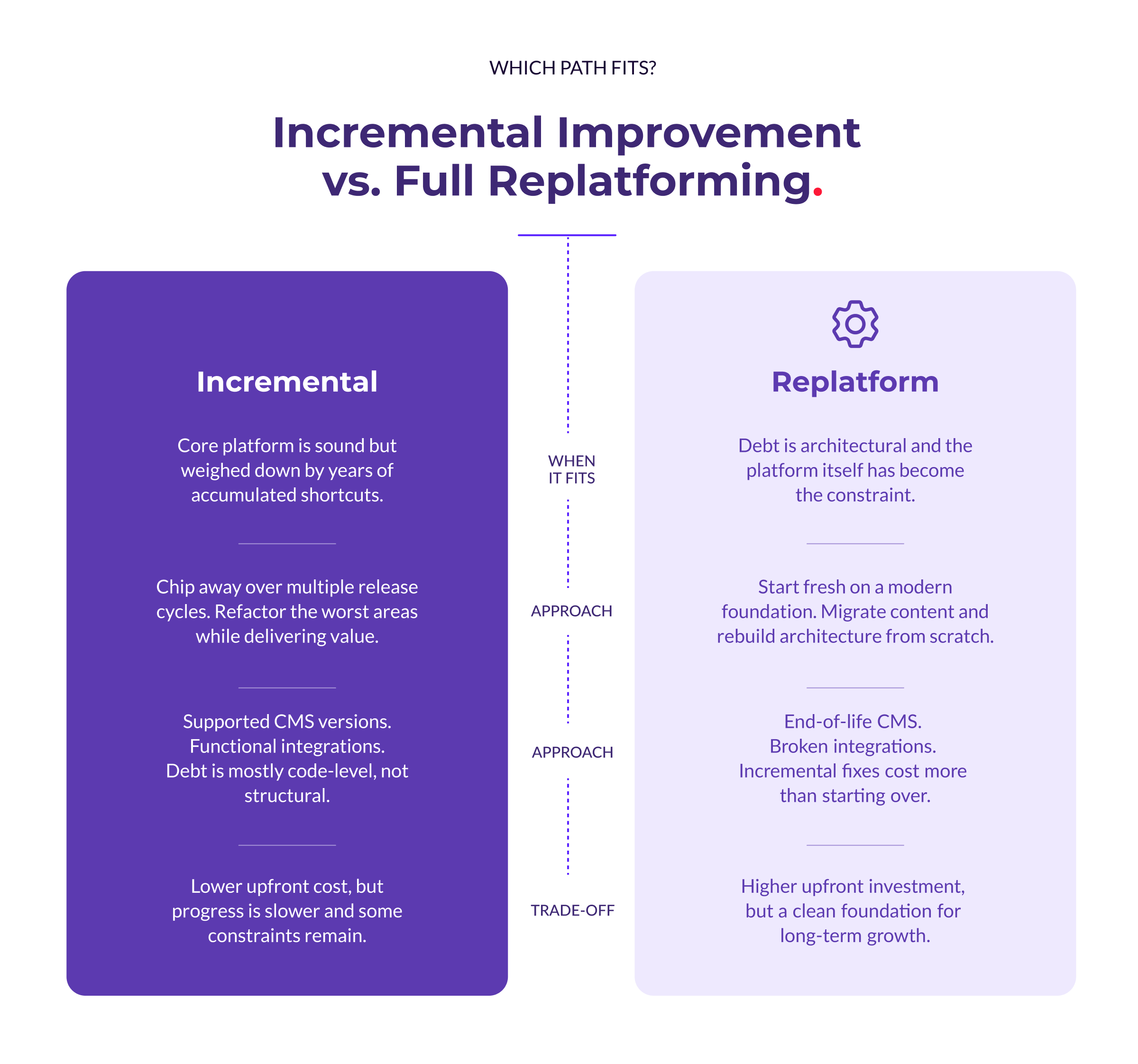
Incremental improvement works when the core platform is sound but burdened with years of accumulated shortcuts. You can chip away at the debt over multiple release cycles, refactoring the worst areas while continuing to deliver value on the current system.
Replatforming a legacy website makes sense when the debt is architectural and the platform itself has become the constraint. If your CMS is end-of-life, your architecture can't support modern integrations, or the cost of incremental fixes exceeds the cost of starting fresh, then replatforming is the more financially responsible path.
If you're leaning toward replatforming, our guide to website migration walks through how to build the business case, prepare your team, and manage the process from start to finish.
Build Debt Prevention Into Your Process
Resolving existing debt is only half the equation. Without governance structures in place, you'll accumulate the same problems all over again within a few years.
Organizations that adopt structured approaches to managing technical debt report significantly fewer obsolete systems than those that treat it as a one-time cleanup. Debt prevention includes coding standards that the entire team follows, regular code reviews that catch shortcuts before they ship, documentation practices that preserve institutional knowledge when people leave, and content governance that keeps your site from sprawling out of control.
Without clear ownership, editorial standards, and publishing workflows, you'll accumulate the same mess all over again. Establishing content governance before you invest in a new site is one of the most effective ways to prevent debt from returning.
Why Organizations Choose Drupal to Escape Legacy CMS Challenges
For organizations that determine replatforming is the right move, the choice of platform matters enormously. A new CMS built on the same patterns that created your debt will land you right back where you started in five years.
Drupal's architecture is designed to resist the patterns that cause debt to accumulate in the first place. As an enterprise CMS, Drupal gives organizations the flexibility to extend functionality without the rigid constraints that create debt in proprietary systems. Its modular, standards-based structure means you extend functionality by adding well-maintained modules rather than hacking custom code onto a rigid core. When you need a new capability, you're building on a shared foundation that thousands of other organizations use and contribute to.
Several characteristics make Drupal a strong choice for organizations dealing with legacy CMS challenges:
- Regular, backward-compatible releases keep the platform current without forcing a full rebuild every time a new version ships. Since Drupal 8, migrating between versions no longer requires starting from scratch, which is a significant reduction in the kind of forced debt that proprietary platforms impose.
- A dedicated security team monitors the codebase and patches vulnerabilities quickly, addressing one of the biggest pain points for organizations running older, unsupported platforms.
- Enterprise scalability supports complex, multi-site ecosystems without the kind of architectural fragility that comes from stretching a platform beyond what it was designed for.
- An open-source model that reduces long-term cost of ownership compared to licensed platforms, while giving you full control over your codebase and hosting environment.
Drupal works for large organizations because it's built to grow with them without forcing the same cycle of accumulation and expensive overhaul.
How to Build a Website Modernization Strategy That Lasts
Once you've assessed your debt and chosen a path forward, the final step is building a strategy that prevents history from repeating itself.
Align leadership around the business case.
Technical debt is a business problem, not an IT problem. The costs show up in missed revenue opportunities, slow time-to-market, and security risk. Frame it in those terms when building internal support, because budget conversations move faster when leadership understands what the debt is costing the organization in language they already speak.
Define success metrics before you start.
What does "done" look like? Faster time to deploy content updates? Reduced developer hours spent on maintenance? Improved page load speeds? Fewer security incidents? Set measurable targets so you can prove the value of the investment after the fact.
Choose the right partner and platform.
A modernization project is only as good as the team executing it. Look for a partner with deep experience in your industry and your chosen platform, one that understands the difference between building something that looks good at launch and building something that stays healthy for years after.
Plan for continuous evolution.
The goal is building a platform and process designed for continuous evolution, where iterative improvements based on real user feedback replace the cycle of neglect and expensive overhaul.
Moving Forward
Technical debt is not a verdict on the decisions your organization made in the past. Every shortcut, every "good enough" solution, every deferred upgrade happened for a reason. Growth, competing priorities, limited resources. These are normal pressures that every organization faces.
But there comes a point where the accumulated weight of those decisions starts costing more than it would to address them. When your website can't support your goals, when every improvement takes longer and costs more than it should, when your team spends more energy maintaining the old than building the new, that's the signal to act.
The path forward starts with understanding what you're dealing with, making strategic choices about where to invest, and partnering with a team that builds for the long term.
If your website's technical debt is blocking your next move, we can help you assess the damage, build a plan, and execute it. Let's talk.
Contributors