AI Search Optimization: How to Get Traffic From AI Chatbots and Get Cited by LLMs

- How to Get Listed in AI Platform Responses and Master AI Search SEO
- Generative AI Referral Traffic: Does It Drive Website Visits?
- How LLMs Choose Which Sources to Cite
- 7 Ways to Increase Website Traffic From AI Search
- How to Track AI Referral Traffic in GA4
- What This Looks Like in Practice
- Frequently Asked Questions About AI Search Traffic
- Where to Start With AI Search Optimization
Someone asks ChatGPT which volunteer management platforms suit a mid-sized nonprofit, or asks Google's AI Mode to compare two graduate programs. The answer comes back as a few paragraphs with a handful of links underneath.
If your page is one of those links, you've been cited, though a citation doesn't guarantee a click. Many people read the summary and stop there. The ones who do follow a link arrive having already read an overview of what you offer, and they want the full version. That visit is generative AI referral traffic, and it frequently appears in the analytics of the sites we look after.
We've written this guide for the teams who run university, government, nonprofit, and business-to-business (B2B) websites because the mechanics of getting cited don't change by sector.
How to Get Listed in AI Platform Responses and Master AI Search SEO
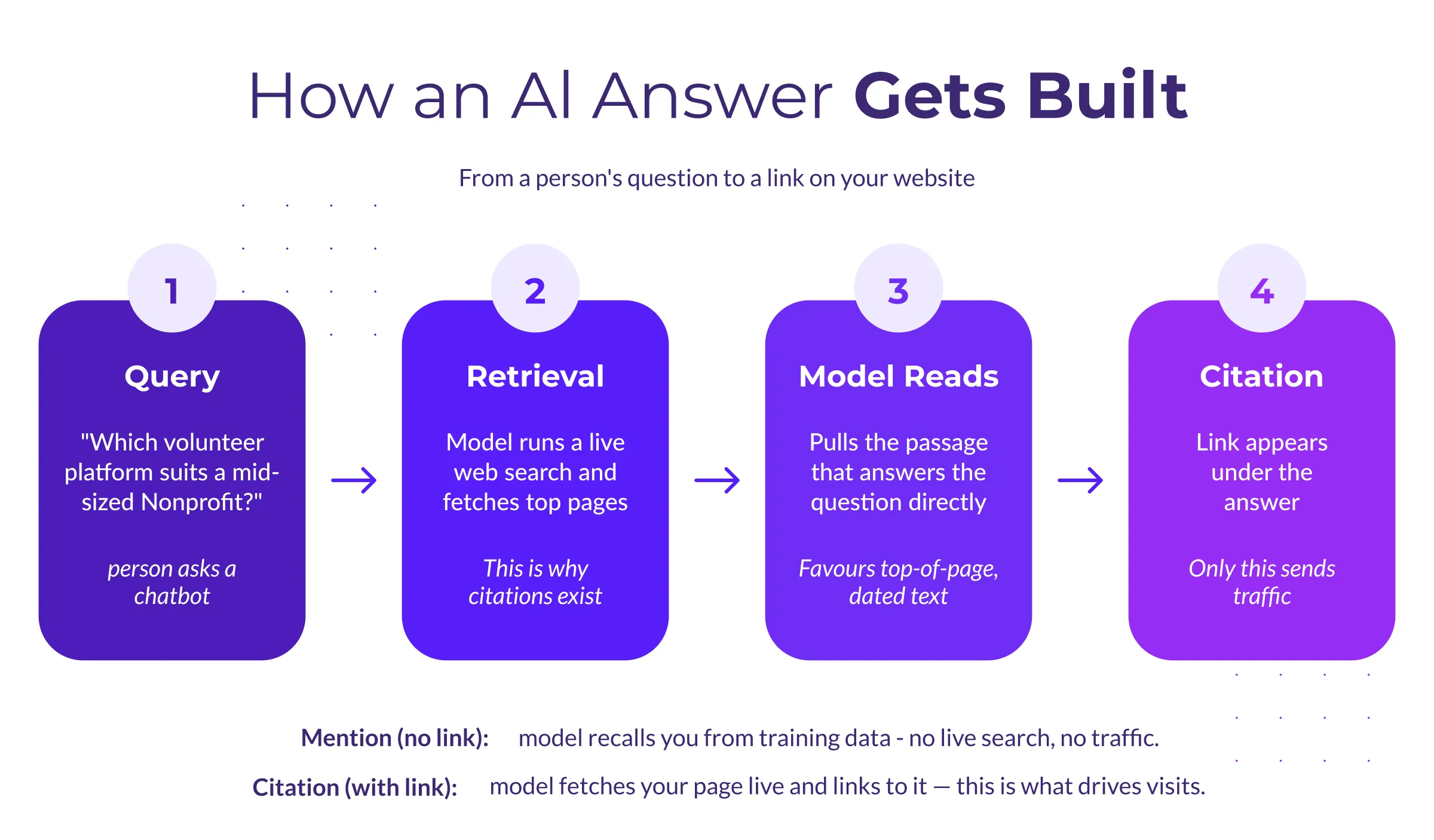
Getting listed means an assistant either mentions your organization in an answer or links to one of your pages as a source. Only the link sends traffic. It happens when a crawler can reach the page, a model can pull a clear passage from it, and the page ranks well enough to be fetched in the first place. A few terms first, since the industry uses them loosely.
- Large language model (LLM): The software behind ChatGPT, Gemini, Claude, and similar assistants.
- AI Overviews and AI Mode: Google's two AI answer formats. An AI Overview appears at the top of a regular results page. AI Mode is a separate conversational tab.
- Retrieval-augmented generation (RAG): The step where an assistant runs a web search, reads the top results, and writes its answer from them. This is why citations exist. A model answering from training data alone may mention you with no link.
- Generative AI referral traffic: Visits that begin with a click on a link inside an AI-generated answer. Answer engine optimization (AEO) and generative engine optimization (GEO) are the industry's labels for earning it. Both mean the same thing as AI search optimization.
Generative AI Referral Traffic: Does It Drive Website Visits?
Yes, though it remains a fraction of what Google's classic results send. The share grows month over month. The people who click out of an answer also arrive with more intent than the average search visitor.
The visit has to come from a person. When ChatGPT or Claude fetches your page to build an answer, the request appears in your server logs as a bot. AI bots made up 4.2% of HTML requests across Cloudflare's network in 2025. None of it reaches Google Analytics as traffic.
The human clicks are also easy to miss. App clicks often arrive without a referrer, which sends them to Direct in Google Analytics 4 (GA4). A click from an AI Overview is reported as ordinary Google organic traffic, with nothing to distinguish it from a click on a blue link.
How Much Traffic AI Chatbots Send in 2026
Google's AI Mode passed 1 billion monthly users within a year of its global launch. On the chatbot side, about half of US adults use one, four in ten use it to search for information, and six in ten read the AI summaries at the top of Google's results.
The share that reaches websites is much smaller than the usage suggests. In March 2026, AI chatbots sent 3.5 million visitors to the sites Ahrefs measures, about 0.28% of all web traffic, with ChatGPT responsible for the large majority. Next to Google organic, that's tiny. It's also growing faster than any other referral source Ahrefs tracks. Claude referrals grew fastest over the year while ChatGPT grew slowest, even though ChatGPT still sends the most.
Set up tracking for all five assistants from the start.
Fewer Clicks, Better Visitors
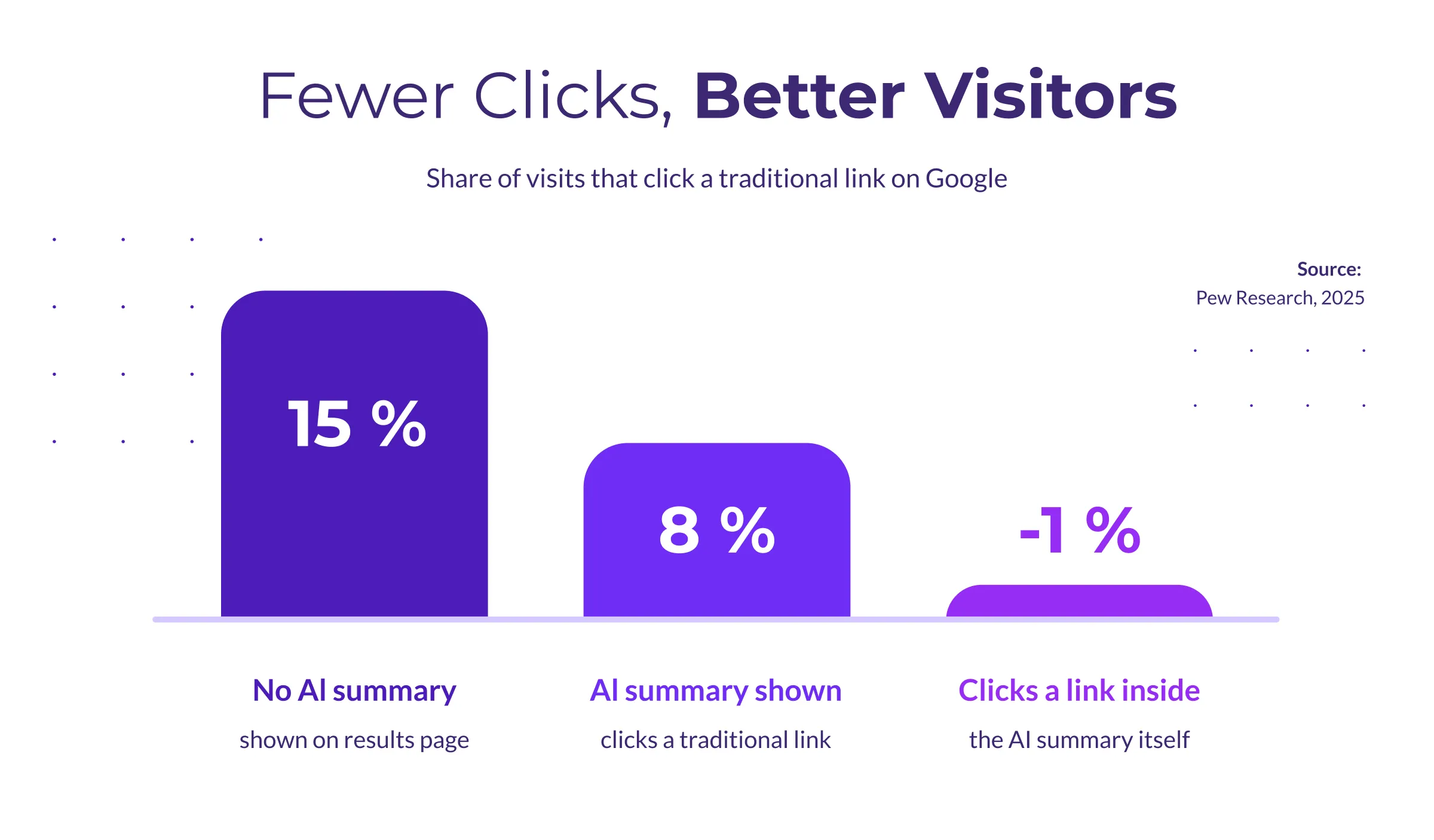
AI answers cut clicks on informational searches. When Google shows an AI summary, people click a traditional result on 8% of visits, compared with 15% when no summary appears. They click a link inside the summary itself about 1% of the time.
The visitors who do click behave differently. Among people who use a chatbot for news, 42% click through to the original source always or often. Only one in five say they trust the chatbot's answer, so the reader who clicks anyway wants to check it against your version.
Google describes clicks from pages with AI Overviews as higher quality clicks. In the Ahrefs data above, AI visitors were half a per cent of traffic and one in eight signups.
How LLMs Choose Which Sources to Cite
"If your content is a mess, AI will amplify the mess," as one speaker at the Drupal AI Summit in New York put it this spring.
An assistant can mention your organization from what it learned in training, or it can cite your page after fetching it during a live search. Mentions come from how often credible third parties talk about you. Citations depend on whether your page is crawlable, current, and easy to pull a passage from.
Getting cited by LLMs means working on both.
What the Citation Studies Have in Common
In a controlled experiment, researchers from Princeton and IIT Delhi rewrote web pages to see how much of the original content ended up in AI-generated answers.
Adding direct quotations lifted visibility by up to 40%, adding statistics by about a third, and citing sources by about a quarter.
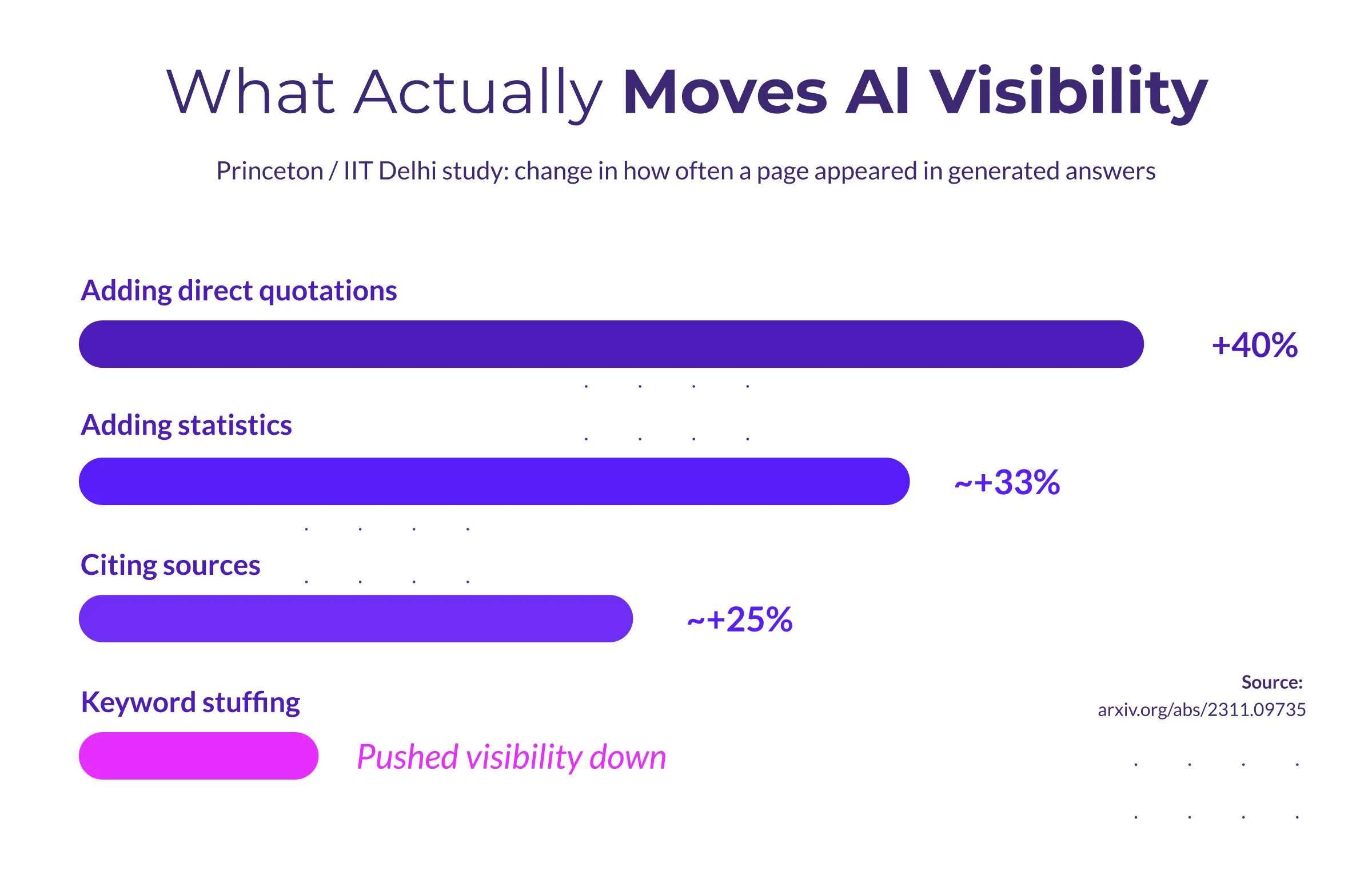
Keyword stuffing pushed visibility down.
The broader citation research agrees on three more things.
- Assistants favour pages with a visible, recent date, more so than classic search does.
- They read the top of a page more closely than the bottom, so an answer buried in paragraph nine rarely makes the cut.
Domain authority still applies because live retrieval starts from a web search and skips the pages that don't rank.
Each Platform Has Its Own Source Preferences
In an academic analysis of citations from OpenAI, Perplexity, and Google models, low-credibility sources barely appeared. Each provider leaned on its own short list of outlets, with Wikipedia and news sites for ChatGPT, Reddit and review sites for Perplexity, and blogs plus the organic top ten for Google's AI Overviews. Google's AI Overviews also favour a source type the others don't.
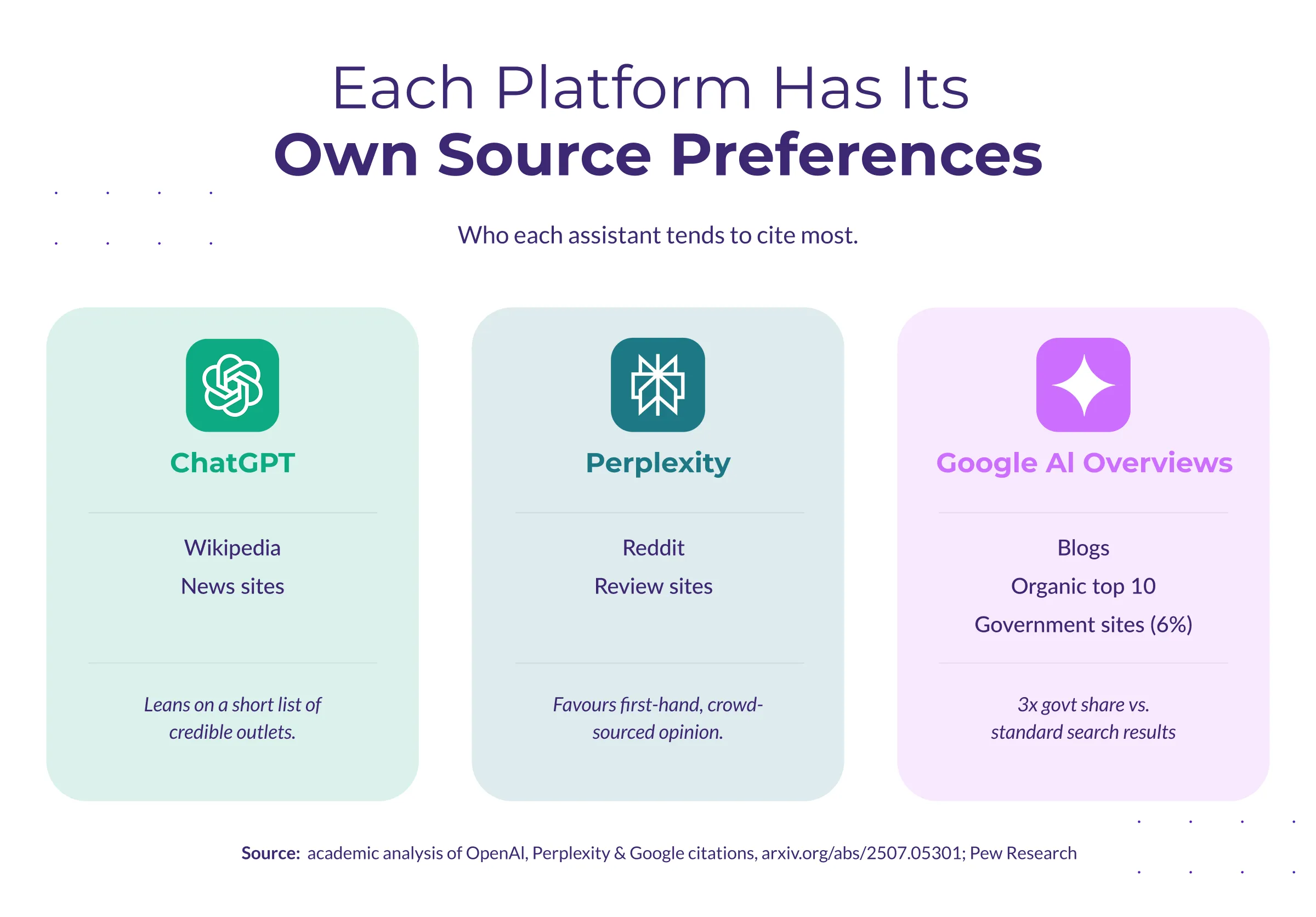
Government sites made up 6% of citations in AI summaries, three times their share in standard results. For a municipality or a public agency the AI answer may be an easier place to show up than the blue links ever were.
7 Ways to Increase Website Traffic From AI Search
Access comes first in the list below, then content, authority, and targeting, because a page an assistant can't fetch can't be cited however good it is.
Google's own guide says you don't need llms.txt, Markdown copies of your pages, content chopped into fragments, or structured data as a requirement. It also warns against paying for mentions. Nothing below asks for any of those.
1. Make Your Site Easy for AI Crawlers to Read
Before anything else, check robots.txt for the search crawlers. OpenAI runs OAI-SearchBot for ChatGPT search and GPTBot for training data as separate agents. Blocking one doesn't block the other. Anthropic publishes three separate crawlers on the same split. If your organization blocked AI training a year ago, check that the rule didn't also block the search bots. Those are the ones that produce links.
Then make sure the content is served as HTML because assistants read the page as delivered and anything that only appears after JavaScript runs may never be seen. Keep a clean heading hierarchy, keep page speed up, and mark up the basics.
2. Lead With the Answer and Structure Pages for Extraction
Put the answer in the first paragraph under each heading, then explain it. A model building an answer pulls the passage that addresses the question most directly. It also weights the top of the page over the bottom.
Question-form subheadings help because they match how people phrase prompts. Tables help with anything comparative. The semantic HTML that lets a screen reader move through a page is the same structure a model uses to find the passage it wants, so proper heading tags, list markup, and descriptive link text all do double duty.
3. Publish Original Research and First-Hand Expertise
When ten pages say the same thing, a model picks one and ignores the other nine. The way out is to publish something the other nine don't have.
In the Princeton experiment, statistics and quotations were the two edits that helped most. Both depend on having original material:
- A survey or dataset you gathered yourself
- Client results you have permission to publish
- A named expert, on your staff or a client's, saying something in their own words
- Testimonials, community stories, and interviews, since nobody else can publish them
Google's own list of what does well in its AI results is "an in-depth review, an original post, a unique perspective or a thoughtful first-person analysis." Put a named author on the page with a short bio, and date it.
4. Earn Brand Mentions on Third-Party Sites
Unlinked mentions on credible sites are how a model learns your organization exists before it runs a search. Industry lists, directories, trade press, guest articles, and podcast appearances all feed that. So do Reddit threads and YouTube videos, which some assistants retrieve on purpose.
Keep your description of yourself consistent everywhere it appears, including your Google Business Profile, your About page, and your Organization schema, so the model describes you the same way each time.
The one limit is that mentions have to be earned. Google names inauthentic mentions as the thing to avoid.
5. Keep Content Fresh and Visibly Dated
Assistants favour recent pages and read the date on them. Put a last-updated date near the top of every article and keep it accurate. Set a refresh cadence for the pages that already get cited, since a page that's already in the answers is easier to keep there than a new page is to get in.
Prune pages that no longer say anything current. On a large site, the Drupal AI module can write updated meta descriptions and alt text automatically, so a refresh doesn't get held up by hundreds of small metadata edits.
6. Target Bottom-Funnel, Comparison, and Service Pages
A summary can answer an informational question in full. It can't enroll a student, book a program, or choose a vendor, which is why AI referrals land on homepages, service pages, program pages, and comparison articles far more often than organic search does
The keywords that still convert are the ones where a summary can't finish the job, like comparing two graduate programs or checking whether a platform meets a procurement requirement.
Write those pages with the specifics an assistant needs to recommend you, meaning what you offer, who it's for, and how you differ from the alternatives.
7. Keep Ranking on Google, Because AI Overviews Start There
Google's AI features run on the same index as its blue links. A page needs to be indexed and eligible for a snippet to appear as a supporting link in an AI Overview or AI Mode. Since AI Overviews almost always include a page from the organic top ten, ranking on page one is still the shortest route into the answer. The same technical requirements Google applies to classic search apply here.
How to Track AI Referral Traffic in GA4
GA4 has no AI channel, so AI referrals get filed under Referral while app-based clicks with no referrer land in Direct. Three settings pull the traffic you can see into one place.
Set Up GA4 to Isolate AI Referrals
- Filter by referrer: In any traffic report, filter Session source on a regular expression (regex) covering the assistants (chatgpt.com, openai.com, perplexity, gemini.google.com, claude.ai, copilot.microsoft.com, deepseek.com). ChatGPT also appends utm_source=chatgpt.com to every link it shows. A filter on that parameter catches ChatGPT clicks that arrived without a referrer.
- Build an exploration: Add landing page as a dimension against the same source filter. This shows which pages assistants cite and where visitors go next. It's also the list you'll refresh first under strategy five.
Create a custom channel group: Define an "AI" channel with the same regex and order it above Referral. AI traffic then gets its own bucket in the standard reports, where you can compare it with organic and direct over time.
What GA4 Can't See
Clicks from Google's AI Overviews arrive in GA4 as ordinary organic traffic, with no way to separate them. Google Search Console covers part of what GA4 misses with its new Generative AI performance reports, which every site has had access to since August 31, 2026.
The reports show how often your pages appeared in AI Overviews, AI Mode, and the generative AI features in Discover, broken down by page, country, device, and date. They don't show clicks or the queries behind each impression yet. Use them to see which pages Google is putting in AI answers, and use GA4 to see what visitors do after they click.
Bing Webmaster Tools goes a step further for Copilot. It shows how many times Copilot cited each URL and the grounding queries it ran before citing it.
What This Looks Like in Practice
Before AI answers were a consideration, two of our clients had already invested in the signals that get a page cited today.
DPL Financial Partners: Ranking Depth That AI Engines Draw From
DPL Financial Partners runs a commission-free annuity marketplace for registered investment advisors, a field where sources have to be trusted. DPL chose a long-term service agreement over a one-time redesign and treated search as a standing priority. Over that partnership, organic search traffic grew 190%. The site went from 148 to 240 top-10 keywords, with 84 in the top three.
Each of those rankings is a page an assistant reads when someone asks the question behind it.
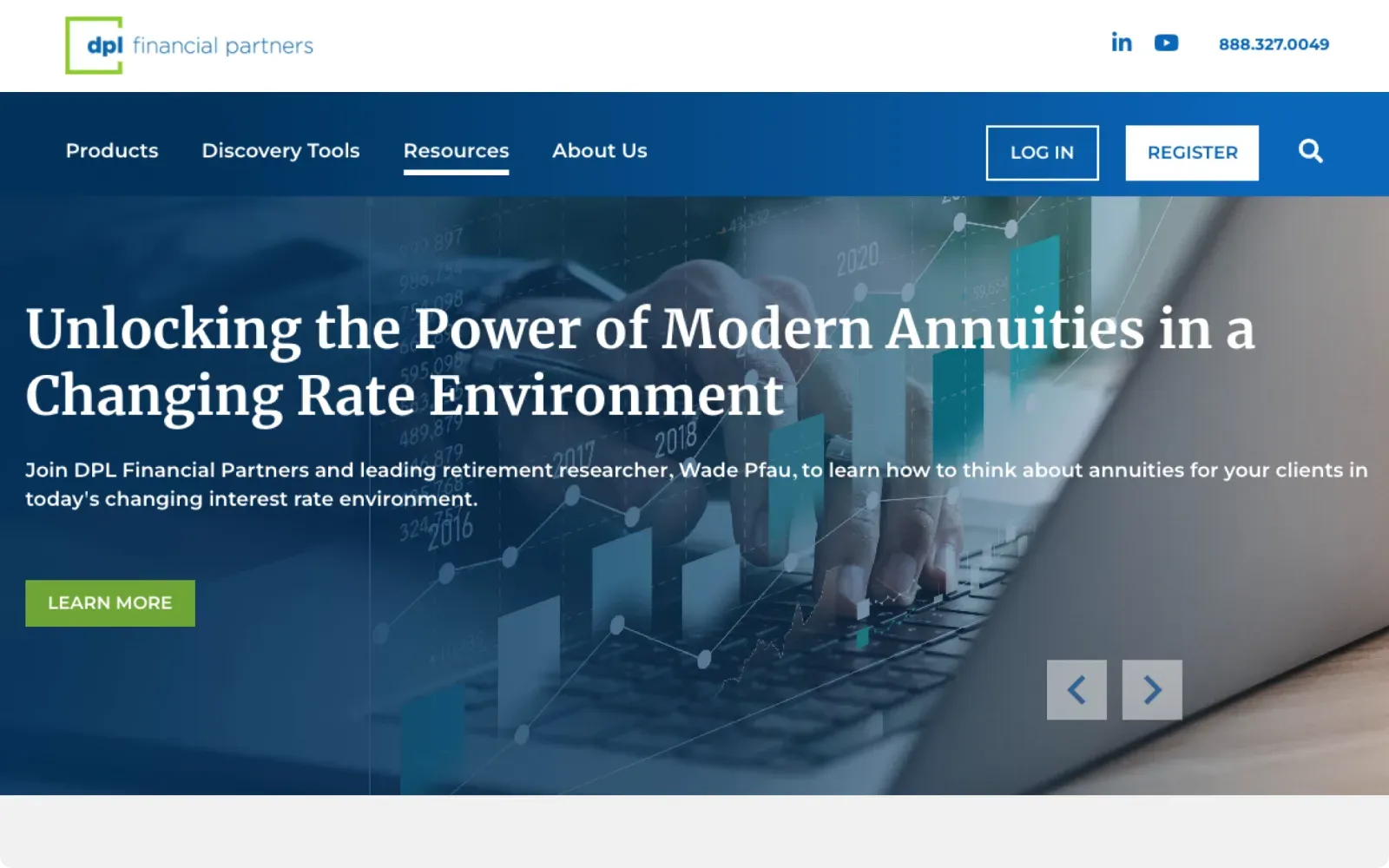
DPL Financial Partners grew organic search traffic 190% and moved from 148 to 240 keywords in Google's top ten. Read the full case study.
YMCA of the Triangle: Schema and Local Structure for Extractable Pages
The YMCA of the Triangle serves 94,000 members across 22 locations in North Carolina. Each location needs its own findable page. The Y prioritized those pages. We implemented location page schema, metadata, and internal linking so every branch is described in a form assistants can read. Within months, search impressions rose 129%, organic traffic 24.6%, and average engagement time 68%. A question like "which YMCA near Raleigh has a pool" is the kind of prompt an assistant answers from structured location data.
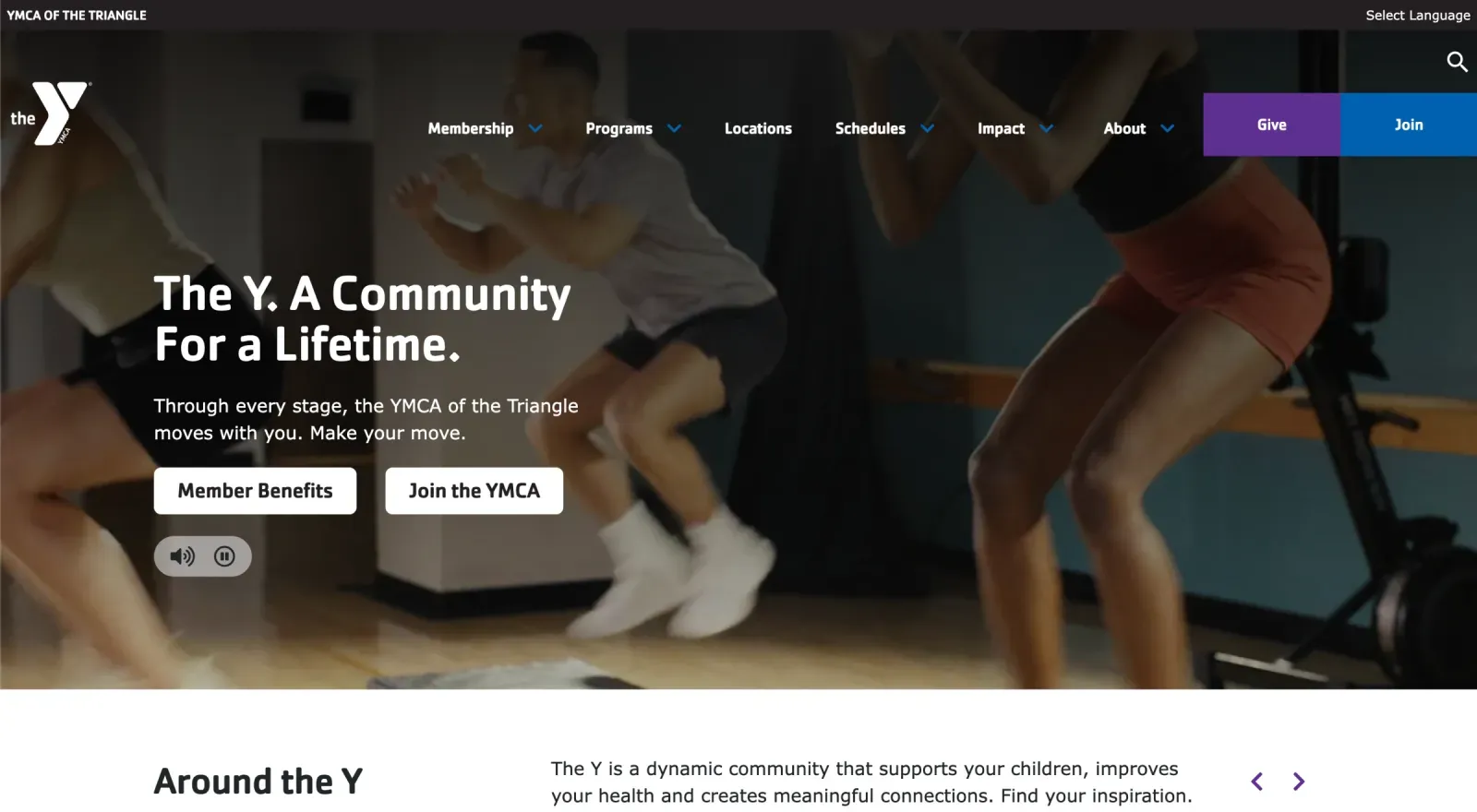
After the YMCA of the Triangle structured its 22 location pages with schema and metadata, search impressions rose 129% and organic traffic 24.6%. Read the full case study.
Frequently Asked Questions About AI Search Traffic
How do I get my content cited by LLMs?
Make sure the search crawlers (OAI-SearchBot, Claude-SearchBot, PerplexityBot, and Googlebot) can reach the page, then give the model something specific to quote. Original statistics, direct quotations, a clear answer in the first paragraph, and a recent date each raised citation rates in controlled tests.
What are the best ways to increase website traffic by AI?
This phrase gets used for two different things. Using AI tools to do SEO faster, like generating metadata or finding keywords, is one. Getting traffic from AI assistants is the other, and it's the subject of this article. For the second, the seven strategies above apply in order, from crawler access through to strong Google rankings. Judge the channel on conversions per visit rather than on its share of total traffic.
Where to Start With AI Search Optimization
Three starting points, by effort:
- An access and schema audit: Check robots.txt for every AI crawler, confirm your pages render as HTML, validate your schema, and set up the GA4 channel group. A developer and an analyst can do it in a day.
- A refresh of the pages already getting cited: Use the GA4 exploration to find them, then update the dates, move the answer to the top, and add data and quotes where you have them.
- A full content strategy engagement: Structured content, governance, and information architecture come first. Our content strategy and SEO services teams start with an audit of where you're already cited and what's blocking the rest.
If you'd like a second opinion on where your site stands, talk to us and we'll look at your AI referral data with you and say what we'd do first.
Contributors