Catching the Drupal Breeze: Insights from Driesnote Chicago 2026

Drupal is evolving so quickly that it’s hard to guess what’s coming next, until the DrupalCon keynote by Drupal Founder, Dries Buytaert, warmly known as the ‘Driesnote’ pulls back the curtain. That’s the moment when the community leans in, ready to see the newest ideas take shape.
Our team has just had a chance to hear yet another wonderful Driesnote at DrupalCon Chicago 2026. We supported the event as a Champion Plus Sponsor and also brought a team of exceptional speakers. That was the best celebration of our 25th anniversary, combined with Drupal turning 25 this year.
Here are the Driesnote highlights we’re most excited to share: new functionalities that expand what Drupal can do, demos that reveal how these features work in practice, and the inspiring enthusiasm of Drupal leader Dries, reminding us that the platform’s strength lies in building it together.
Driesnote Chicago 2026: latest innovations uncovered
Drupal CMS 2.1, Drupal core 11.3, and the big performance boost
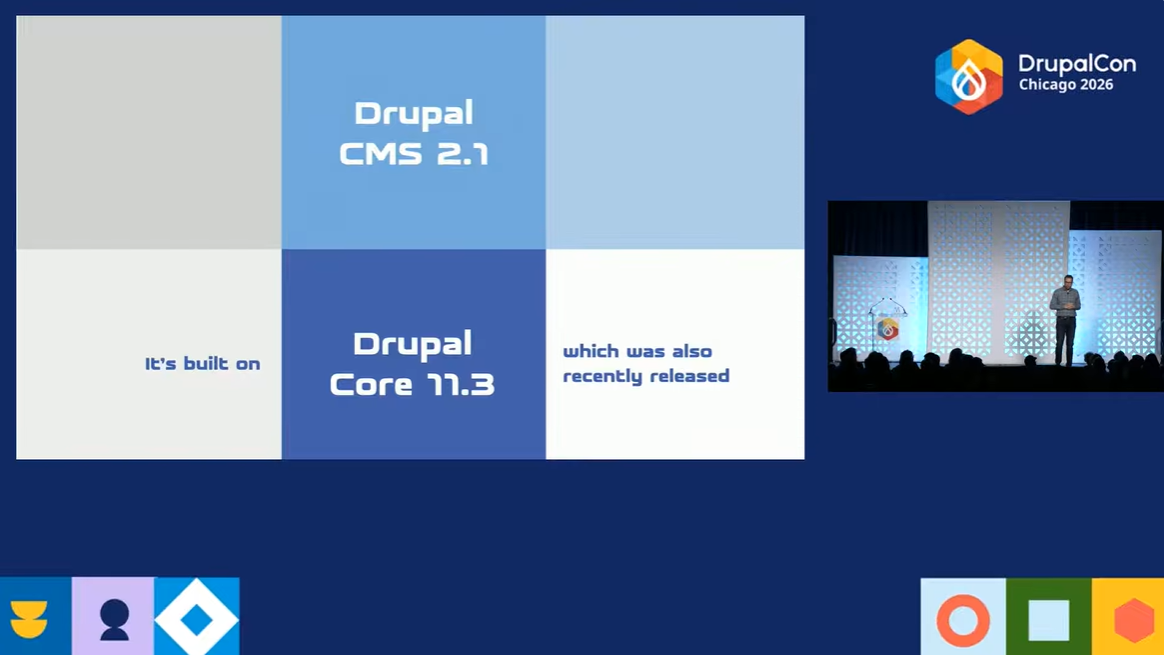
At this keynote, Dries announced the upcoming release of Drupal CMS 2.1. This will be a great update for this unique product — a curated CMS where plenty of functionalities are pre-configured, and user-friendliness is at the top of the list.
Dries emphasized that Drupal CMS was built on top of Drupal core. The latest release of Drupal core, 11.3, introduced Drupal’s biggest performance boost in a decade. For example, over the last 18 months, there was a 50% reduction of database queries for uncashed pages. This is beneficial for Drupal CMS as well. Overall, it means that every Drupal site, if upgraded to the latest version, will perform much more efficiently.
Some of the impactful features we will see in Drupal CMS 2.1 are up next in this Driesnote Chicago 2026 overview.
Site templates and Marketplace
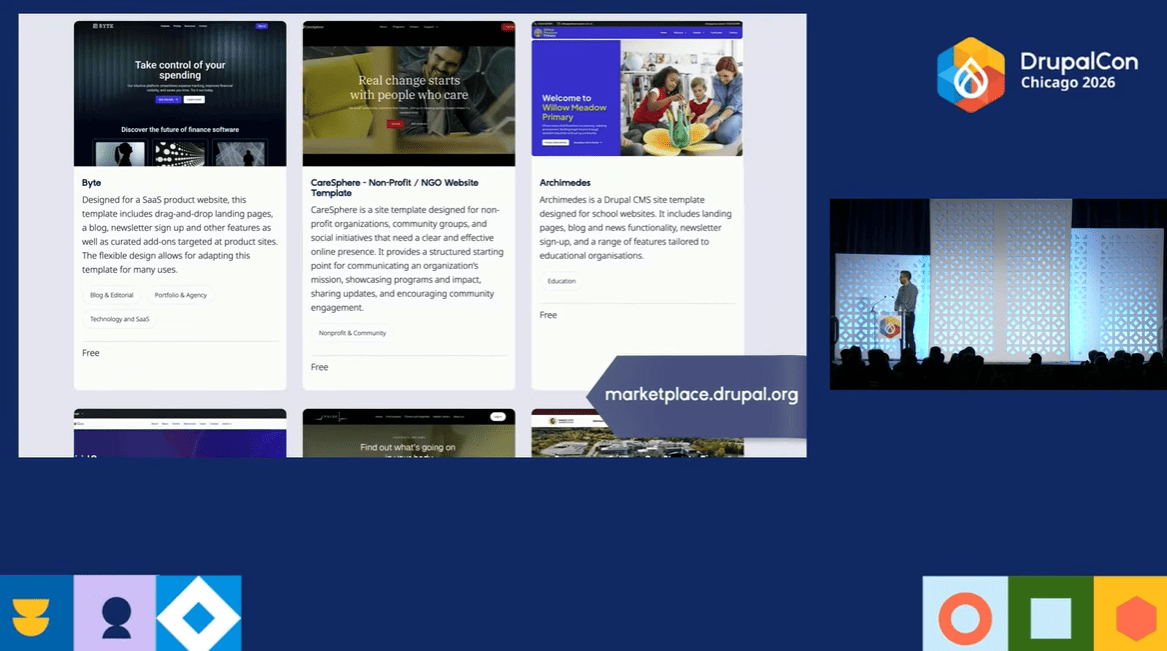
The idea of Site templates and Marketplace was introduced back at DrupalCon Atlanta 2025. In Chicago, Dries was excited to announce that there are already eleven site templates and a basic marketplace has been launched at marketplace.drupal.org. Dries hopes that website templates and Marketplace are going to bring lots of new people to Drupal.
Nonprofit, higher ed, SAAS, healthcare, government, and event website templates are tailored to help users reach industry-specific goals. There are free and premium templates, but all of them share Drupal’s open-source values. You can also connect directly with the template creators if you need support.
You can install templates directly from Drupal CMS 2. Create and customize new template pages using Drupal Canvas, the next-generation page builder.
AI page building
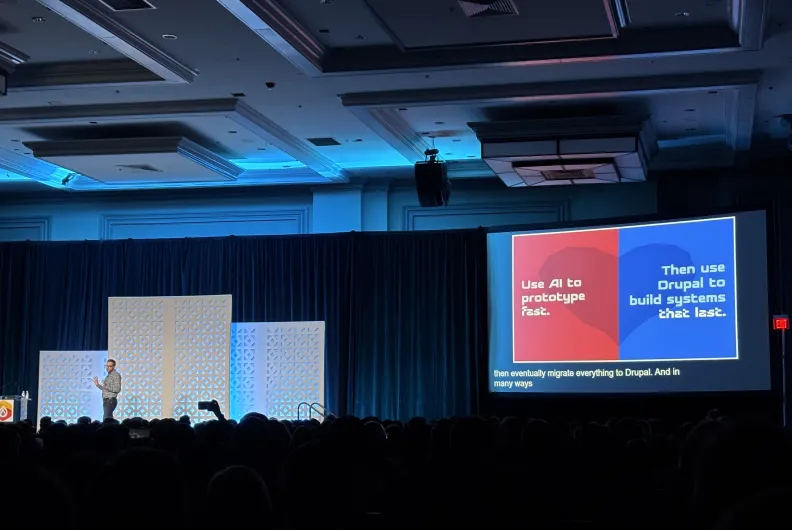
Next, Dries introduced something that he said could make the audience both impressed and uncomfortable, because that’s what he admitted, he felt himself. How about having AI quickly spin up a website just from your prompt?
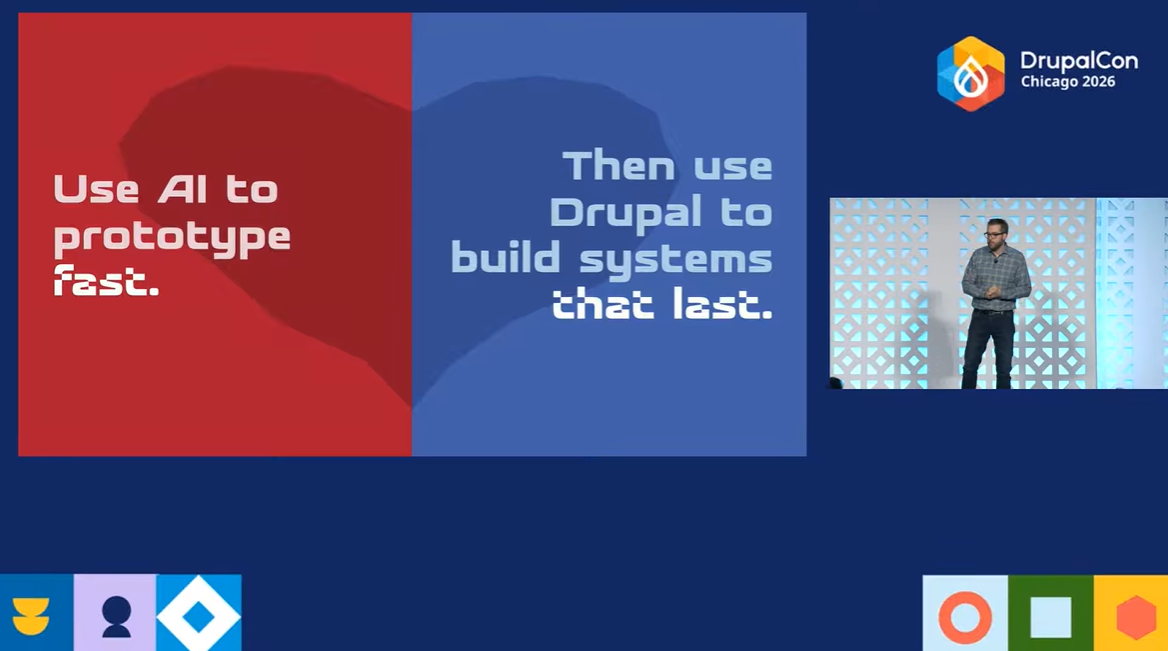
The Driesnote demo featured an imaginary event site about the future of Drupal, “Vision 25” that was created using the Lovable UI. The speed of its creation was impressive, and the website looked great. However, on closer look, you could see that the content was embedded directly into the generated site. The site was missing the things you’d need for mature editorial experiences, like structured content, workflows, permissions, governance, accessibility, multilingual support, and reusable editorial components, everything we love about Drupal.
To fix that, the site was rebuilt using Drupal’s best practices with Canvas CLI and OpenAI Codex, and the content became structured and editable. And once shaped into a reusable foundation, the site could even be exported as a starting point for future projects.
Creating better content with the revamped Context Control Center
“No one handles content like Drupal,” said Dries, and it’s hard to disagree. Drupal is very strong at structuring content, categorizing content, adding Alt text, migrating content, setting up content workflows, and so on. “We’ve helped many organizations get content out in the world and we’re exceptionally good at content management.”
However, today the real challenge isn’t producing more content, but producing better content. Great content depends on multiple roles working together — subject experts, writers, designers, SEO specialists, and more. In reality, though, teams are often under time pressure, collaboration breaks down, and the result is content that’s “good enough,” but not truly effective.
Drupal AI is the solution. At Driesnote Vienna 2025, we saw the Context Control Center (CCC), a new tool that enables Drupal AI to generate relevant content pages based on the saved brand guidelines. Furthermore, we saw a demo of Autonomous AI agents keeping content updated across the site based on the changes in Context Control Center.
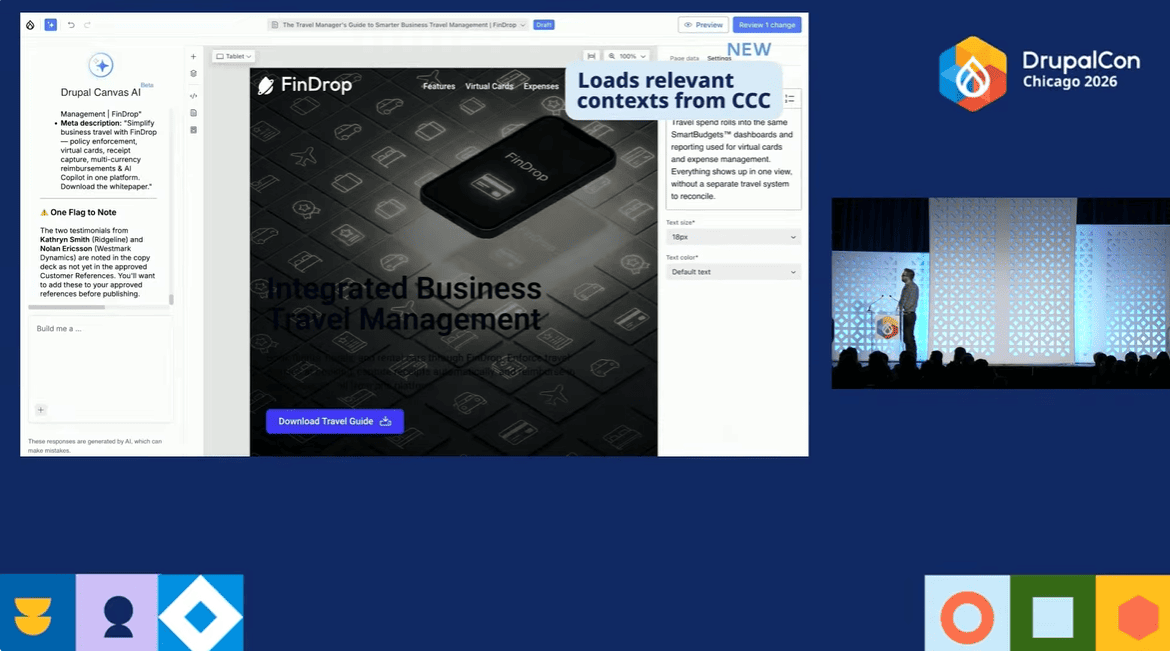
Huge work has been done on CCC since DrupalCon Vienna, and now it’s almost production-ready. We’ve had a chance to take another sneak peek at it in Chicago, featuring Jordan, a marketing manager at a fictional mid-sized financial services company named “Findrop.”
Context Control Center at the demo site had the information like the writing tone and voice alongside the visuals and imagery, abbreviation and formatting rules, content strategies for each page type, key value propositions with the latest sales pitch deck, ideal customer profiles, Google Analytics data, and much more.
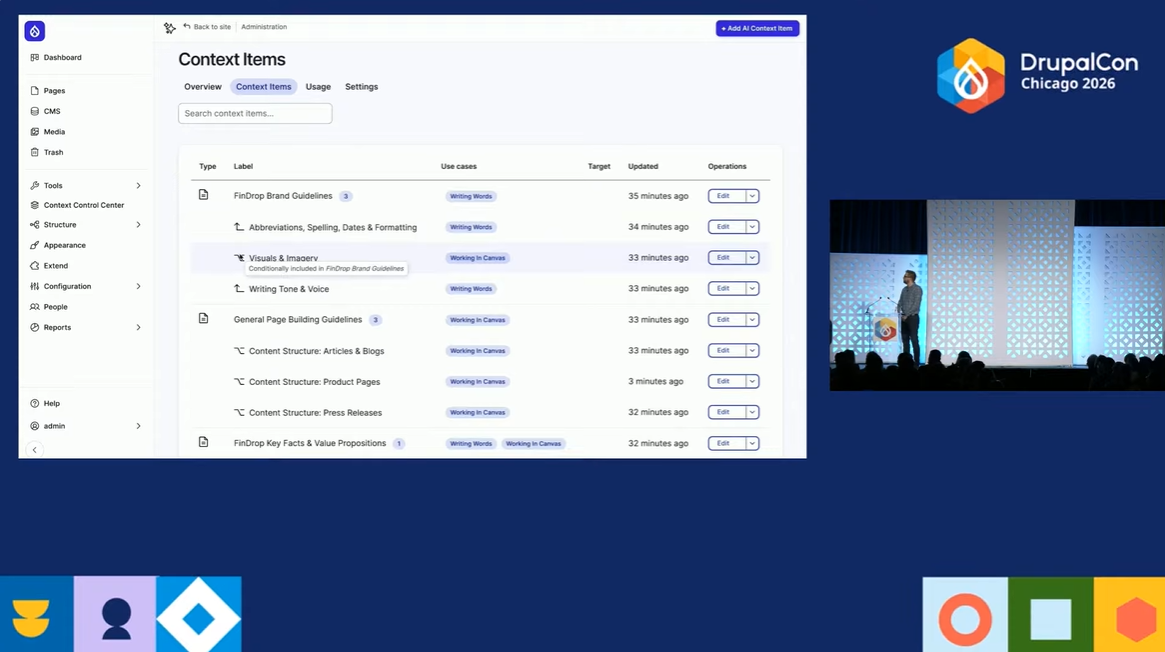
The system knows which context to load: when Jordan builds a product page, AI loads the product page content structure and brand guidelines.
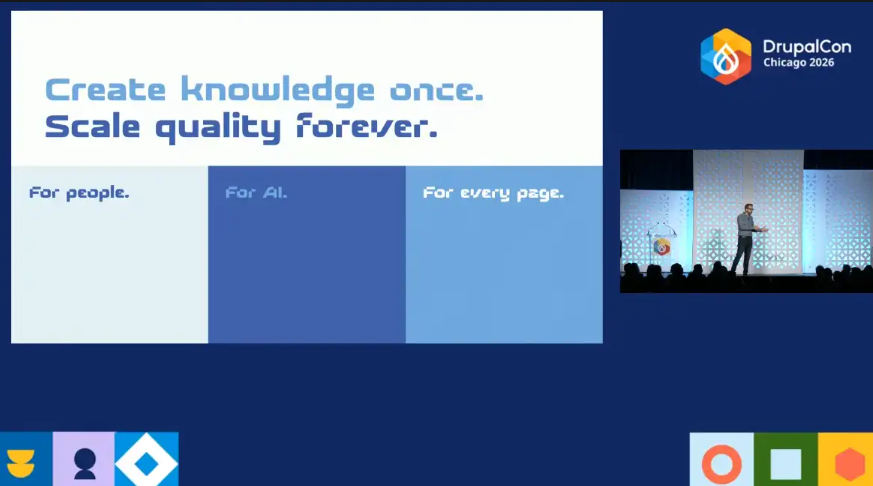
“I really do believe that the context control center will be a differentiator for Drupal because it essentially lets you create knowledge once and then scale quality forever,” said Dries.
There was also a live demo of how Drupal AI could turn a raw content copy into a production-ready page based on CCC. Jordan took the unstructured copy deck from the product team and fed it into Canvas AI. The AI recognized this as a product page and mapped it into the site’s UI components, pulling brand voice, typography, and imagery guidelines from the Context Control Center.
AI was asking clarifying questions to Jordan and making adjustments in the process. For example, it converted the existing section into an interactive set of FAQ accordions, added people’s pictures, added links to the relevant pages, generated structured data for the page, and more.
AI-controlled content performance
Even great content loses its edge over time. What if your Drupal website could continuously monitor the content performance?
This area of functionality in the Context Control Center that Dries called “dynamic context” is one of the hottest innovations right now. As mentioned earlier, CCC was pulling data from Google Analytics in the demo, and its ability to connect with external data sources, CRM systems, and other tools in your marketing stack should expand in the near future.
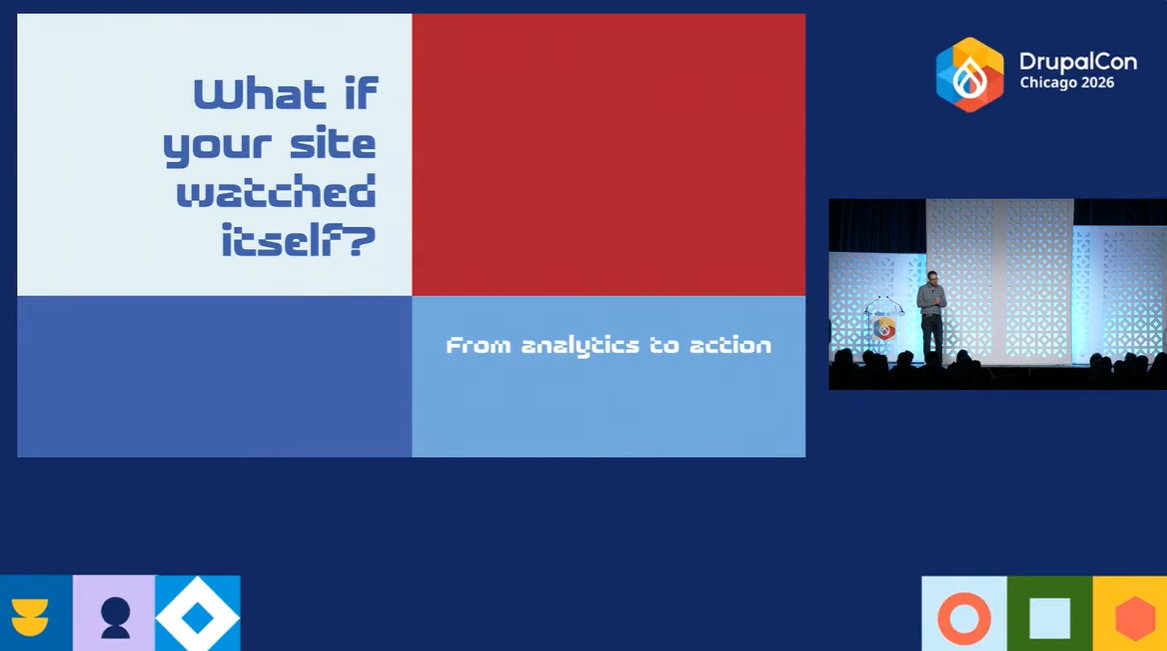
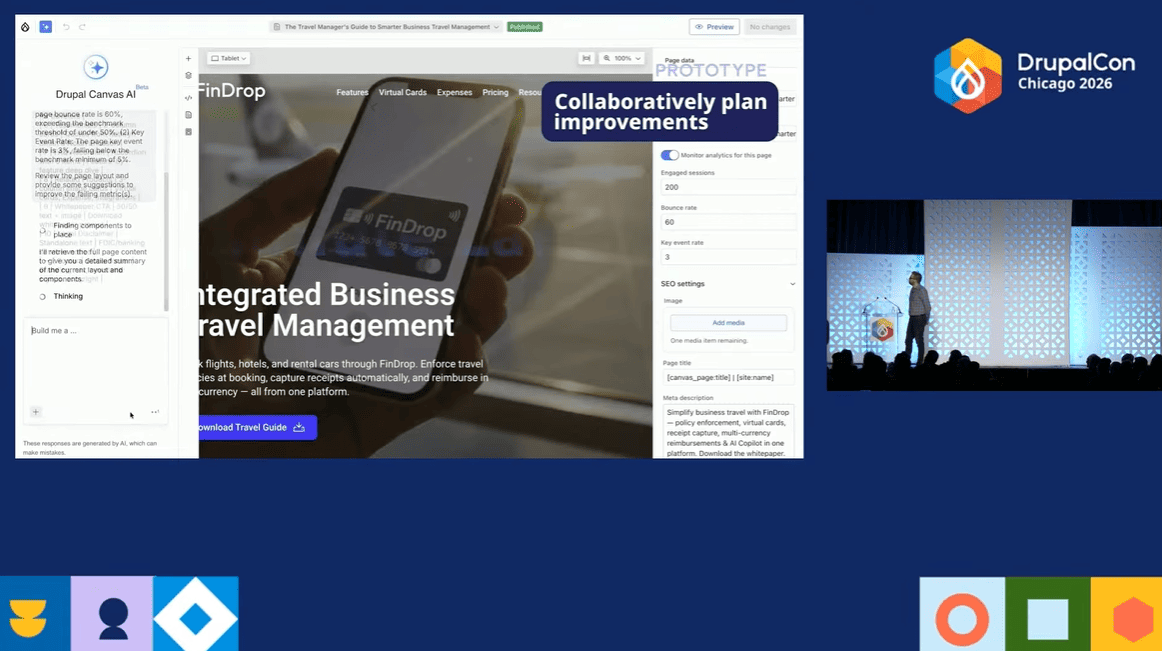
For this part, Dries provided another exciting demo. In the demo, Jordan marked a page as important and defined key metrics to track: bounce rate, engaged sessions, and white paper downloads.
Drupal AI continued to analyze the content performance based on the CCC data, and two weeks later, it flagged an issue. The page’s messaging had become misaligned with revised sales positioning introduced after it went live, meaning the content itself needed updating. AI prepared a list of recommended improvements.
Jordan also learned from their sales team that Findrop Travel is much faster to set up, directly solving the biggest pain point of their major competitor. Based on this, the team decided to update the CTA and run one final check. Drupal AI pulled in the updated context added after launch, proposed improvements, and caught a brand violation before the page went live, helping to avoid potential legal issues.
ECA: radically easier to use
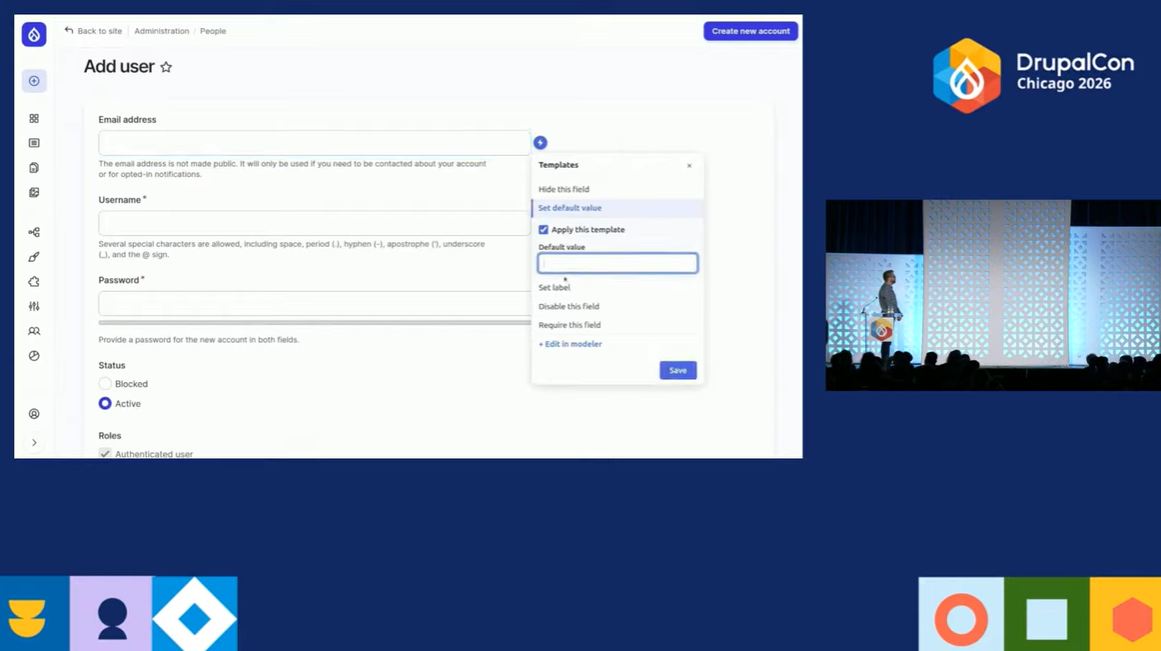
Next at Driesnote Chicago 2026, the floor was given to an outstanding module creator who tackled a challenging task. The ECA (Event-Condition-Action) module is Drupal’s powerful automation tool. Its creator, Jurgen Haas (jurgenhaas), had done a huge revamp, making the tool much more user-friendly to content editors and marketers.
Jurgen demoed the new, easy-to-use ECA templates with pre-built automations. Currently, this has been implemented for online forms because it’s a common use case, but work is underway to make this available for everything in Drupal.
For technical users, Jurgen introduced a new workflow modeller that has been built from scratch. It is based on React Flow, an open-source library that provides a customizable React component for building interactive graphs, flowcharts, and more. The new modeller includes long-expected features such as testing and debugging.
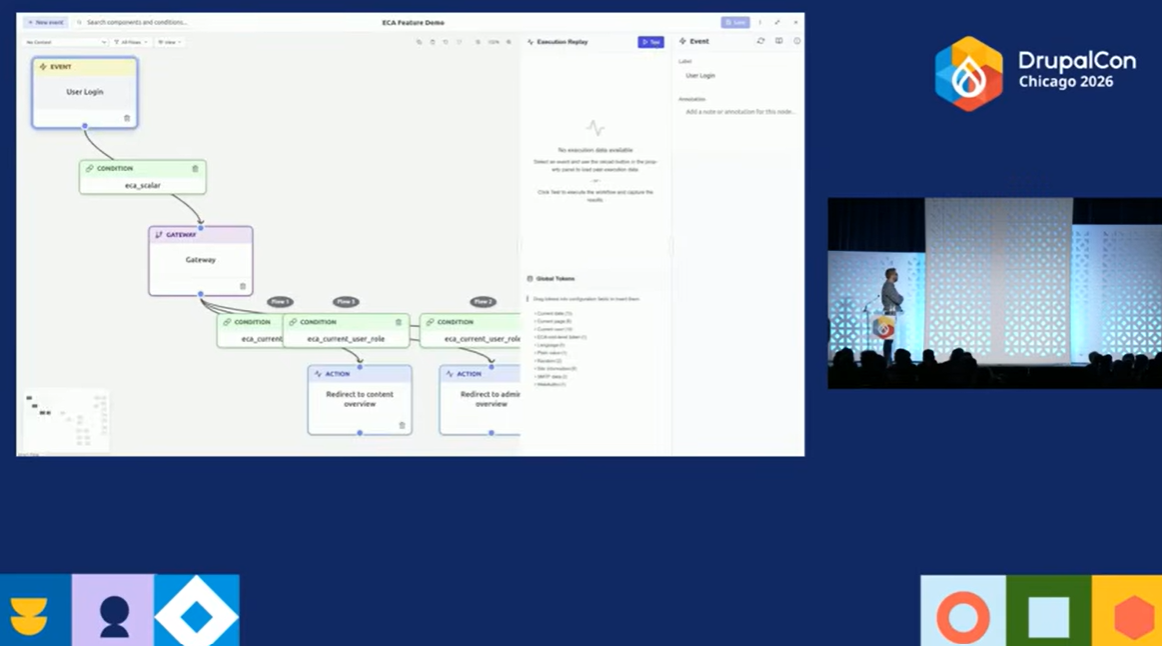
As a result, non-technical users get in-context automation, while power users get a professional visual editor with testing and debugging built in. This means two completely different experiences within ECA as a unified system.
AI: amplifying expertise, not replacing it
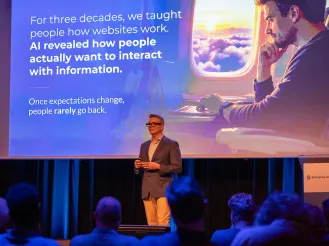
At his keynote, Dries spoke extensively about AI, understandably so. It’s reshaping the foundations of the web, bringing both excitement and uncertainty. But Drupal is ready to meet this challenge — together, as a community.
“AI can destabilize our foundations, and it can simultaneously rebuild them stronger than before. And that's not a contradiction. That's more like a puzzle, a puzzle that we have to solve together.”
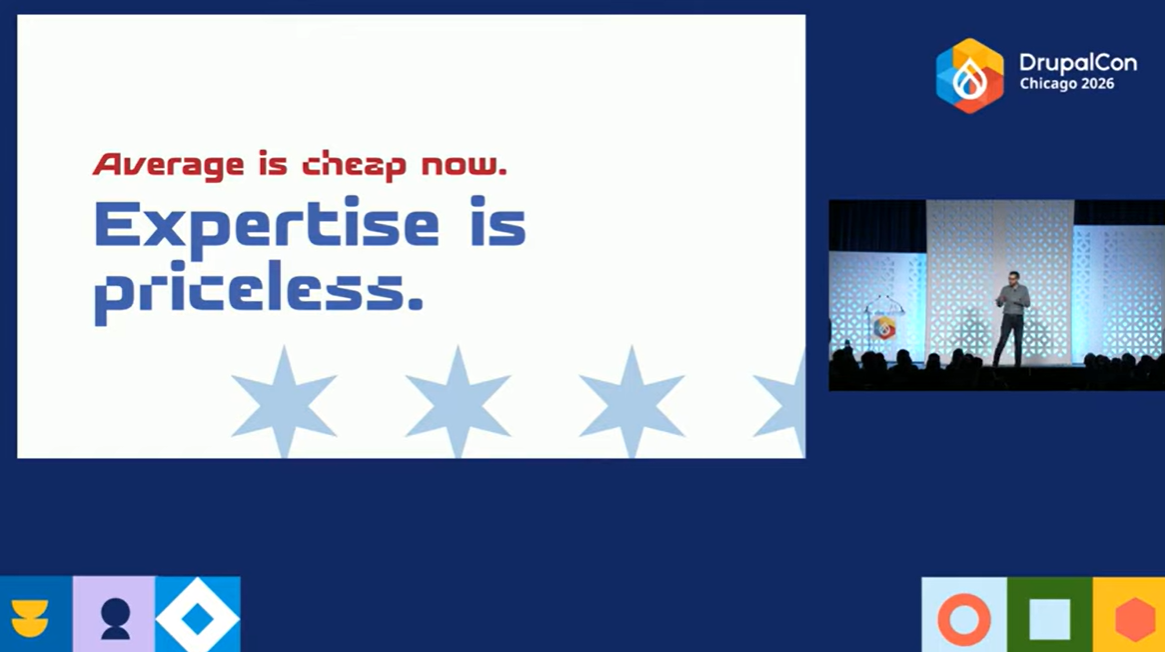
He also emphasized what AI cannot replace: deep, authentic expertise. The kind built over 25 years of Drupal’s history, through care, collaboration, and trust, patch by patch.
In a world increasingly filled with “AI-generated average,” it’s the people who truly care and go deep who stand out.
Dries encouraged everyone to get involved and help shape what comes next. And our team is proud to be part of this forward momentum.